
Choosing a rug seems simple until you roll one out and realize it looks oddly small, swallows the room, or stops just short of the furniture.
In design terms, rug size is about scale. Get it right and the whole room suddenly feels pulled together. Get it wrong and even beautiful furniture can look disconnected or cheap.
The good news is that rugs follow fairly predictable size patterns. Once you understand the standard dimensions and a few layout rules, it becomes much easier to picture what will actually work on your floor.
Below is a room by room guide to the most common rug sizes and how to choose them with confidence.
What are the standard Rug Sizes?
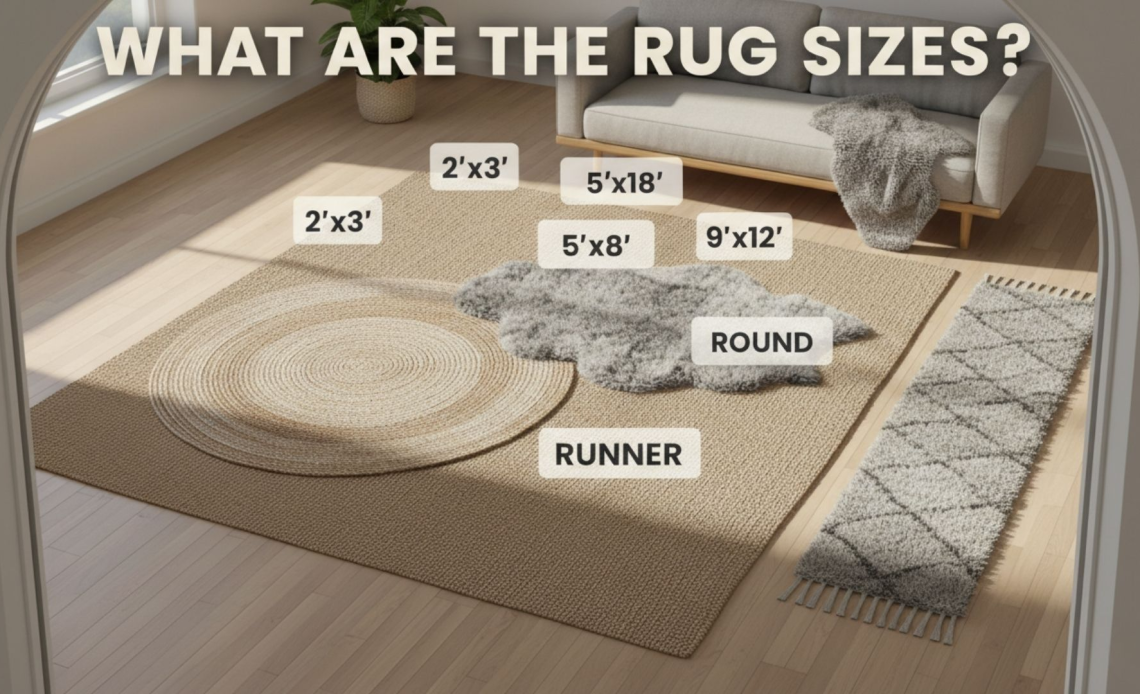
Most rectangular area rugs fall into a familiar set of dimensions. You will see small accent sizes like 2 x 3 feet and 3 x 5 feet, classic medium sizes like 4 x 6 feet, 5 x 7 or 5 x 8 feet, and 6 x 9 feet, then larger room grounding sizes like 8 x 10 feet, 9 x 12 feet, 10 x 14 feet and 12 x 15 feet.
Each range tends to play a particular role. The smallest sizes work as door mats, bath mats, or under a single accent chair.
Medium sizes suit compact living rooms, home offices, kids rooms, or to define a reading nook. Large and extra large rugs are designed to anchor full seating groups or to sit under beds and dining tables.
Runner rugs are long and narrow. Typical sizes include about 2 to 3 feet in width with lengths of 6, 8, 10, or sometimes 12 feet.
You will see combinations such as 2 x 6, 2.5 x 8, or 3 x 10 feet, which are ideal for hallways, galley kitchens, and beside beds.
Round and square rugs follow similar logic. Common round sizes are 4, 6, 8, and 9 feet in diameter. Square rugs often track the rectangular sizes, for example 6 x 6 or 8 x 8 feet.
These are useful when you want a softer or more symmetrical shape, especially under round dining tables or in square entryways.
Read More: 10 Affordable Curtain Ideas For Every Room
Living Room Rug Sizes
The most important rule in a living room is that the rug should relate to the seating group, not to the coffee table alone.
Designers often aim for at least the front legs of the sofa and chairs to sit on the rug so the pieces read as one conversation zone rather than separate islands.
A good visual guide is the two thirds rule. Ideally, the rug should feel slightly wider than the sofa so that the arms do not hang awkwardly over the edge.
When possible, leave a band of visible floor between the rug and the walls, often around 8 to 18 inches, so the room does not look completely carpeted but still feels grounded.
In a small living room with a loveseat or a compact sofa, a 5 x 7 or 5 x 8 rug can work if you can at least get the front legs of the main seating pieces on it.
For slightly larger spaces, a 6 x 9 often gives enough depth in front of the sofa for both a coffee table and comfortable foot space.
For most standard living rooms, 8 x 10 is the dependable go to size. It usually allows all front legs on the rug and can accommodate a sofa, a couple of chairs, and a coffee table without feeling cramped.
In generous or open plan rooms, 9 x 12 or 10 x 14 rugs often make more sense, since they allow either all the furniture legs on the rug or a clearly defined seating island within a larger space.
If your favorite rug is a bit too small, you can layer it over a larger, simpler rug in a neutral color. This helps avoid the floating postage stamp look that happens when a small rug sits alone in the center of a big room.
Bedroom Rug Sizes
Bedroom rugs do not just soften the floor. They visually frame the bed and make the whole room feel more finished.
The right size depends mainly on the bed size and how much clearance you have at the sides and foot.
Rug sizes for a queen bed
For a queen bed, several sizes can work, depending on the room. A 5 x 8 rug suits compact bedrooms where the bed is fairly close to the walls.
The rug usually sits horizontally under the lower two thirds of the bed, stopping before the nightstands. This still gives a soft landing zone at the sides and foot of the bed without crowding the room.
In medium sized rooms, 6 x 9 is a very flexible choice. It typically allows more rug to show at the sides and foot while still tucking under most of the bed frame.
In larger rooms, 8 x 10 or even 7 x 10 rugs can create a hotel like effect, with a generous border of rug around the bed and plenty of softness underfoot when you step out in the morning.
Read More: What Are The Mattress Sizes?
Rug sizes for a king bed
King beds are wider, so they usually need larger rugs to stay in proportion. An 8 x 10 rug is often the minimum that feels balanced under a standard king, giving enough width on either side of the bed for a comfortable step.
In rooms with more floor space, a 9 x 12 rug is ideal because it frames the full bed and nightstands while still showing some floor at the edges. In very large primary bedrooms, a 10 x 14 rug can anchor a seating area at the foot of the bed as well.
Small bedrooms and alternatives
If your bedroom is too tight for a full sized area rug under the bed, you still have options. One approach is to place two runners, one on each side of the bed, often in the 2 x 6 or 2.5 x 8 range, so you always step onto something soft.
Another is to use a single 3 x 5 rug at the foot of the bed to add color and texture without crowding the walls.
Dining Room Rug Sizes
The key rule for dining rooms is that the rug needs to be larger than the table, not just match its footprint. You want every chair to stay fully on the rug, even when pulled out for someone to sit down or stand up.
A common guideline is to let the rug extend at least about 24 inches beyond all sides of the table so chair legs do not catch on the edge.
For a small four seat table, a rug around 6 x 9 feet usually works well, giving enough room for chairs without overwhelming a modest dining area.
A standard six seat rectangular table often sits nicely on an 8 x 10 rug. For larger eight seat tables or long farmhouse tables, 9 x 12 is a safer choice, especially in open plan spaces where the rug also helps define the dining zone.
If you have a round table, look at round rugs. As a quick check, measure the diameter of your table and add at least 48 inches.
A 48 inch table often pairs well with a 8 foot round rug so there is comfortable space for the chairs all the way around.
Hallways, Kitchens And Entryways
Smaller spaces still benefit from correctly scaled rugs. At the front door, a 2 x 3 or 3 x 5 rug is common.
It should be wide enough to catch dirt and moisture as people step inside, but not so deep that it interferes with the door swing.
In long hallways or beside a row of cabinets, runners in the 2 x 6, 2.5 x 8, or 3 x 10 range add softness underfoot and visually guide you through the space.
In kitchens, slim runners in front of the sink or between island and counter can relieve pressure on your feet and back.
Look for sizes that leave a small border of visible flooring at the cabinets so the rug feels intentionally placed rather than like a strip of wall to wall carpet.
For mudrooms, laundry rooms, and back entries, medium sizes like 3 x 5 or 4 x 6 work well. They provide more coverage than a tiny mat but are still easy to pick up and clean.
Read More: How To Paint Kitchen Cabinets?
Measuring Tips And Common Mistakes
Before you buy, always measure the room and the main furniture pieces. Note the width of your sofa, bed, or table, as well as door clearances and any floor vents.
Then decide how much rug you want visible beyond the furniture, usually somewhere around 8 to 18 inches for a balanced look in most rooms.
A practical trick is to outline the proposed rug size directly on the floor using painter’s tape or masking tape. Live with it for a day if you can.
This immediately shows whether the rug will crowd a walkway, disappear under furniture, or leave odd strips of bare floor at the edges. It is much easier to adjust tape than to exchange a large rug.
The most common mistake is going too small. A rug that floats under a coffee table or sits just under the bed legs and nowhere else tends to make the room feel disjointed and cheaper than it is.
Designers almost always advise sizing up when you are between two options, especially in living and dining rooms where the rug ties the whole layout together.
Conclusion
Rug sizes are not mysterious once you view them as tools for proportion. A 2 x 3 or 3 x 5 rug is an accent, a 5 x 8 or 6 x 9 rug frames a compact seating group or bed, and an 8 x 10, 9 x 12, or larger rug is what you need to truly anchor a full room.
When you pair these standard dimensions with a few simple layout rules such as front legs on for living rooms, full chair coverage for dining, and generous borders around beds, it becomes much easier to shop with confidence and avoid expensive mistakes.
Take the time to measure, tape out potential sizes, and think about how you move through each room.
Once the rug size is right, the color and pattern become the fun part, and your floors quietly do their job of making every space feel more finished, comfortable, and inviting.