
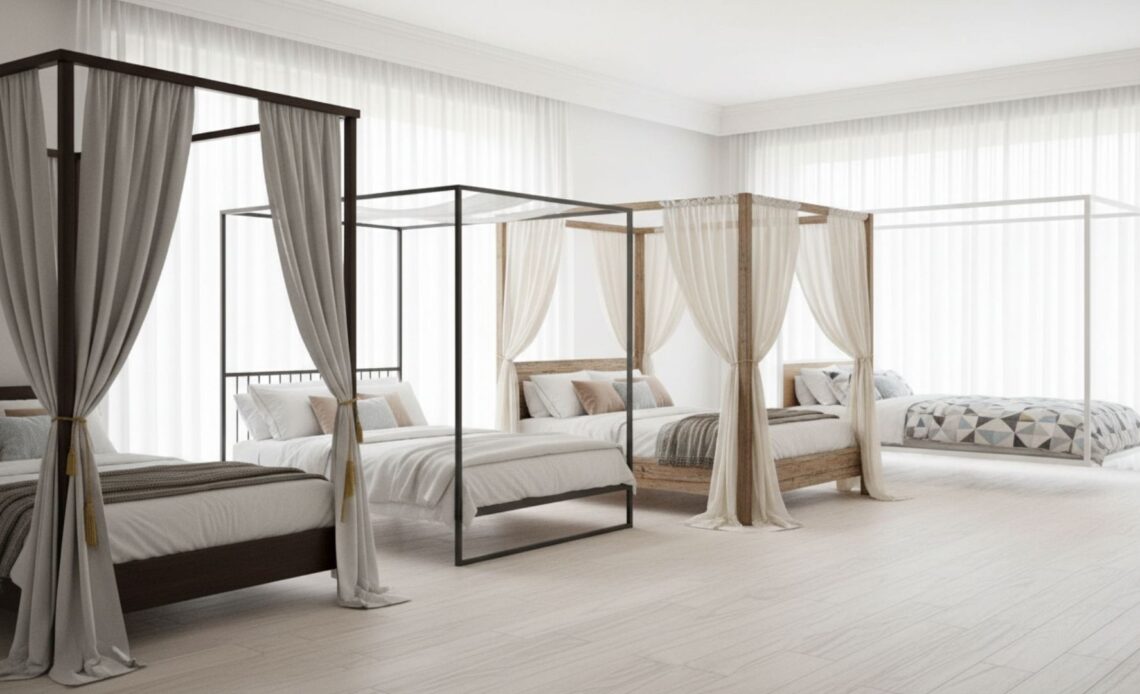
Canopy beds have a certain drama that regular beds simply cannot touch. They frame the mattress, pull the eye upward, and instantly make a room feel more intentional and luxurious, even if the rest of the decor is very simple.
At their core, canopy beds are practical too. Historically they were designed to trap warmth, add privacy, and shield sleepers from drafts and falling debris.
The same basic structure has evolved into everything from light, airy frames to richly draped statement pieces.
If you have ever wondered which canopy style actually suits your space and lifestyle, this guide walks through the main types, what they look like, and when to choose each one.
What Exactly Is A Canopy Bed?
A canopy bed is a bed frame with four tall posts at each corner, connected at the top by rails or beams that can support fabric or stand bare as a graphic frame.
Traditionally, curtains or bed hangings would drape from those upper rails and a solid panel, called a tester, to create a cocoon of fabric around the sleeper.
In older homes without central heating, those fabric walls helped retain heat, muffled noise, gave privacy in shared rooms, and became a subtle way to display wealth and craftsmanship.
Modern canopy beds still use that same basic skeleton, but the execution varies wildly. Some are slim metal rectangles with no fabric at all.
Others echo old world romance with carved wood and layered drapes. Between those extremes sit a lot of practical, livable options.
Read More: How To Hang Sheers On A Canopy Bed?
Classic Canopy Bed Styles
Traditional Four Poster Canopy
When most people picture a canopy bed, they imagine the classic four poster. This style has four substantial posts in wood or metal, connected at the top and often dressed in fabric panels, swags, or curtains.
In its most traditional form, the frame feels solid and architectural. Posts may be turned, carved, or fluted, and the headboard is usually high enough to balance the visual weight of the posts.
Drapes can be pulled fully closed for privacy and warmth or tied neatly at the corners for a decorative effect.
A traditional four poster canopy bed works best in rooms with decent ceiling height. The posts and fabric create a strong vertical presence, so it is ideal when you want the bed to be the true focal point of the room.
Half Tester And Partial Canopies
Half tester canopy beds use a smaller canopy structure that usually covers just the head half of the bed rather than the full length.
Instead of four posts and a full frame, you often get two posts at the headboard and a shallow canopy panel that projects out over the pillows.
It is softer and lighter than a full canopy but still adds a sense of ceremony to the sleeping area. Fabric can fall at the sides of the headboard or be kept minimal with just a valance.
This style suits rooms where you like the idea of a canopy but do not want to visually enclose the entire bed.
There are also partial canopy designs that use full height posts at all four corners but only run rails along part of the bed or just across the head.
These versions keep air circulation open while still providing a structure for a bit of fabric, fairy lights, or simple framing.
Crown And Ceiling Mounted Canopies
Not every canopy bed needs a full structural frame attached to the base. Crown and ceiling mounted canopies create the same romantic effect using hardware on the wall or ceiling instead.
A crown canopy uses a decorative ring or short rail mounted above the headboard. Fabric drapes from this point and falls down behind and to the sides of the bed.
Ceiling canopies extend the idea further by using ceiling tracks or hooks to suspend fabric panels that loosely encircle the bed.
The underlying bed frame here is often a standard platform or box bed, but the fabric installation transforms it into a canopy look.
This is a clever option for small rooms where a full four poster might feel too bulky, or where you already own a bed you like and simply want the canopy effect.
Modern Canopy Bed Styles
Minimal Frame Only Canopy Beds
One of the most popular contemporary interpretations is the frame only canopy bed. In this version, you still get four posts and connecting rails, but the structure is slim and clean lined.
Most homeowners leave it bare or add just a single panel of fabric rather than closing in all four sides.
Visually, a frame only canopy acts almost like a line drawing in the room. It defines the sleeping area and draws the eye up without adding visual weight.
That makes it a good choice for apartments or compact primary bedrooms, especially those with relatively tall ceilings.
If you like modern or minimalist interiors, this is often the easiest starting point. You can always introduce fabric later, but the look remains fresh even if you never do.
Metal Canopy Beds
Metal canopy beds trade carved posts for slim steel or iron tubing. They range from simple rectangular frames to more decorative shapes with curves and details, but even ornate metal versions tend to feel lighter than bulky wood.
Metal canopy frames are popular in industrial, modern farmhouse, and contemporary interiors. Their biggest visual advantage is how thin the structure can be without losing strength.
This keeps sightlines open to windows or accent walls behind the bed while still giving you that canopy silhouette.
From a practical standpoint, metal frames are usually easy to clean and less sensitive to humidity swings than solid wood.
For very humid climates or for people who prefer low maintenance, a painted or powder coated metal canopy bed can be a smart choice.
Upholstered Canopy Beds
Upholstered canopy beds combine the airy frame of a canopy with padded surfaces on the headboard, and sometimes the side rails and posts.
The fabric or leather upholstery softens the outline and adds a tailored, comfortable feel.
These beds are especially good in rooms where you like to sit up in bed to read or work, because the cushioned headboard is much kinder to your back than bare wood or metal.
They also quiet the visual presence of the canopy. Fabric cladding on parts of the frame makes the structure feel integrated into the upholstered headboard instead of sitting separately around it.
Design wise, upholstery gives you a lot of control over mood. Neutral linen can make a canopy bed feel calm and understated, while velvet in a saturated color turns it into a luxe statement piece.
Read More: Bed Skirt Height And Buying Guide
Specialty Canopy Beds
Kids And Teen Canopy Beds
Canopy beds are a natural favorite for kids and teens, partly because they feel like a built in fort.
Scaled down frames, often in painted wood or lightweight metal, create a sense of enclosure without overwhelming a smaller room.
For younger children, fabric canopies with playful prints or bright colors turn the bed into a focal point and a spot for imaginative play.
For teens, a more refined frame only canopy with sheer curtains can feel grown up while still special.
The key with kids and teens is flexibility. Choose a structure that allows the fabric or accessories to evolve over time so the bed can grow with them instead of feeling locked into a particular theme.
Outdoor Canopy Beds And Daybeds
Outdoor canopy beds and daybeds bring the same idea to patios, decks, and poolside areas. Here the canopy is as practical as it is decorative.
The frame can support mosquito netting, sun filtering curtains, or a solid shade panel to make lounging outdoors more comfortable.
Construction matters more outside. Look for treated wood or weather resistant metal, and fabrics that are rated for UV and moisture.
The structure is usually simpler than indoor versions, but the overall effect is still that familiar cocooned comfort.
How To Choose The Right Canopy Type For Your Bedroom?
With so many variations available, the right canopy bed for you comes down to a blend of architecture, lifestyle, and maintenance comfort.
Start with ceiling height and room size. Full traditional four poster canopy beds demand headroom and floorspace so they can breathe.
In compact rooms or those with standard height ceilings, a slim frame only or metal canopy can give you the look without the feeling of being boxed in.
Think about how enclosed you actually want to feel. If you dislike the idea of sleeping inside heavy curtains but love the outline of posts, choose a frame only canopy or a design with posts but no connected top rails.
If you crave the feeling of a private little room, a bed with full drapery or a half tester at the head of the bed will serve you better.
Climate and cleaning habits matter too. In dusty or humid environments, layers of draped fabric will need regular washing to stay fresh.
Opt for a cleaner frame and minimal fabric if you know that stripping and rehanging curtains every few weeks will not realistically happen.
Consider how dominant you want the bed to be. In a very simple bedroom, a traditional canopy can supply all the drama.
In an already detailed space with bold wall treatment or elaborate lighting, a minimalist canopy keeps the bed important without competing.
Read More: Front Elevation Designs for Houses That Look Premium
Conclusion
Canopy beds are not a single look but a family of designs that share one idea: a frame that defines and sometimes encloses the sleeping space.
From traditional four poster styles with full curtains to spare metal frames with no fabric at all, there is a canopy type for every taste and floorplan.
When you understand how each style behaves in a room, choosing becomes less about trends and more about how you live.
Pick the structure that suits your ceiling height, your tolerance for fabric and maintenance, and the mood you want to create.
The right canopy bed will not just decorate your bedroom. It will quietly reset how the entire space feels every time you step inside.