
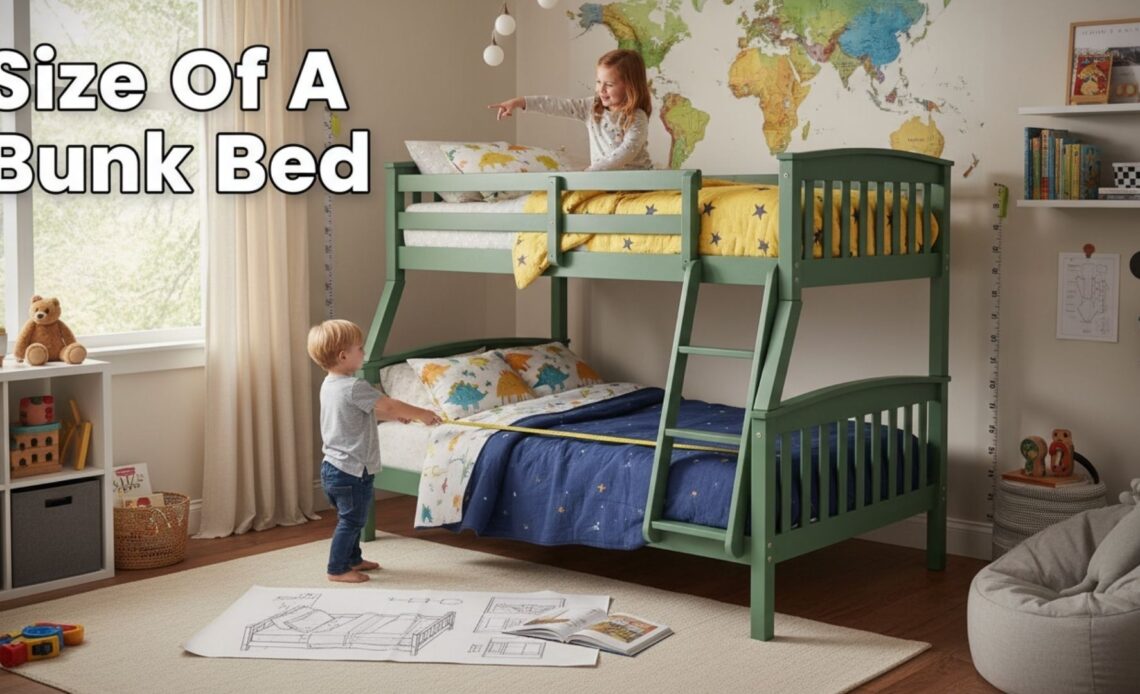
Choosing a bunk bed is not just about picking a cute design. If you misjudge the size by even a few inches, you can end up with a bed that feels cramped, scrapes the ceiling, or makes the room impossible to move around in.
The good news is that bunk bed sizes follow some clear patterns. Once you understand a few key dimensions, it becomes much easier to shop confidently and make sure the bed, the mattresses, and the room all work together safely.
We will break down standard bunk bed sizes, heights, mattress thickness, ceiling clearance, and weight limits, and then pull it all together into practical room planning advice.
What Size Of A Bunk Bed Actually Means?
When people ask about the size of a bunk bed, they often mix up three different measurements:
- Mattress size
This is the sleeping surface: twin, twin XL, full (double), queen, etc. In many markets you will also see the terms single, single XL, and double used for the same sizes. - Bed frame footprint
This is how much floor space the bunk takes up. It is usually a little bigger than the mattress in both length and width because of the frame, ladder, and posts. - Overall height
This is the distance from the floor to the very top of the bunk, usually the top of the guardrail. Height is what determines whether the bed will feel comfortable under your ceiling and how safe the top bunk is.
To choose the right bunk, you need to consider all three: mattress size for comfort, footprint for room layout, and height for safety and ceiling clearance.
Standard Bunk Bed Sizes
Most consumer bunk beds are based on standard mattress sizes. The exact dimensions vary by brand, but there are clear averages you can use for planning.
Twin Over Twin (Single Over Single)
This is the classic children’s bunk: two twin mattresses stacked vertically.
- A standard twin mattress is about 38 inches wide by 75 inches long (roughly 97 by 191 cm).
- Many twin over twin bunk frames are around 75 to 82 inches long and 40 to 44 inches wide once you include the frame and side rails.
- Typical overall heights cluster in the 60 to 65 inch range (about 152 to 165 cm), measured from the floor to the top of the guardrail.
Because the footprint is similar to a regular twin bed, this layout works well in small kids’ rooms where you want to sleep two children without sacrificing floor space.
Twin Over Full
A twin over full bunk has a standard twin on top and a wider full (double) on the bottom. It is popular for shared rooms with an older child or for guest rooms that sometimes host adults.
- A typical full mattress is about 54 inches wide by 75 inches long (roughly 137 by 191 cm).
- Expect the footprint to be about 78 to 82 inches long and 55 to 60 inches wide, depending on how bulky the side rails and posts are.
- Overall height is usually comparable to twin over twin models, often 60 to 65 inches or slightly more if the design is styled taller.
This layout needs noticeably more floor width than a twin over twin, so it works best in medium to larger bedrooms.
Full Over Full
Full over full bunks are designed for teens, adults, or guest spaces where everyone needs more elbow room.
- Both mattresses are full size: about 54 by 75 inches each.
- The frame footprint often ends up in the 78 to 82 inch length and 57 to 62 inch width range.
- Overall heights often reach 65 to 72 inches (165 to 183 cm), as many full over full designs are a bit more substantial structurally.
Because of the wider footprint and heavier frame, full over full bunks claim more space visually and physically. They suit larger rooms and spaces designed with adults in mind.
Other Configurations
You will also see specialty options such as:
- Twin XL or full XL for taller sleepers
- L-shaped bunks that wrap around a corner
- Triple bunks or bunks with a trundle underneath
- Loft beds with one sleeping surface and open space or a desk below
These do not follow a single standard, so you must rely on the manufacturer’s specific length, width, and height measurements instead of approximate rules of thumb.
Read More: Best Age For Bunk Bed: When Is It Safe To Switch?
How Tall Is A Bunk Bed?
Height is where function and safety really intersect.
Across many popular models, the overall height of a bunk bed commonly falls around 60 to 65 inches, measured from the floor to the top of the upper guardrail.
Some designs are lower for younger children, and some high bunks approach 70 inches or more.
The actual usable height is split into:
- Space between the floor and the bottom bunk slats
- Space between the bottom mattress and the underside of the top bunk
- Space between the top mattress and the ceiling
That last piece is the one that keeps heads safe.
Ceiling Height And Safe Clearance
Even if you know the bunk height, you also have to think about your ceiling.
Most safety and design guidance suggests leaving about 30 to 36 inches of space between the top of the mattress on the upper bunk and the ceiling.
With a typical modern ceiling around 8 or 9 feet high, that usually means:
- A standard bunk works comfortably in an 8 foot (2.44 m) room if the bunk is in the 60 to 65 inch height range and you choose an appropriately thin mattress.
- In rooms with lower ceilings or attic slopes, you may need a low bunk or a simple single bed instead.
Always consider:
- Ceiling fans and low light fixtures
- Beams or sloped ceilings that reduce headroom on one side
- Children who like to sit up or read on the top bunk
The aim is simple: no one should be able to bump their head on the ceiling just by sitting up normally.
Mattress Thickness
Mattress thickness does not change the frame dimensions, but it changes how much space is left above the sleeper and how much of the guardrail remains exposed.
Many mattress and bunk specialists recommend keeping the top bunk mattress around 6 to 8 inches thick. Some brands stretch that to about 8 or 9 inches, but thinner is generally safer on top.
The reason: guardrails only protect properly if they rise far enough above the top of the mattress. Standards in several markets require:
- Guardrails to stand at least five inches (about 13 cm) above the mattress surface, and newer proposals push that to around 6.5 inches (about 16.5 cm).
- A minimum vertical distance between the mattress base and the top of the guardrail (for example, one standard sets this at 260 mm, about 10.2 inches).
If you use an overly thick mattress on the top bunk, you effectively shorten the guardrail and reduce safety.
On the lower bunk, where falls are less severe, you can be more generous with thickness, as long as there is still comfortable sitting space.
Read More: Low Profile Vs Standard Profile Box Spring
Weight Limits And Who Will Use The Bunk
The size of a bunk bed is not complete without understanding what it can safely support.
Manufacturers usually specify a weight limit per bunk, and it varies widely:
- Many children’s bunks rate the top bunk between roughly 150 and 220 pounds (68 to 100 kg).
- Adult-rated bunks can support much more, often 250 to 800 pounds per bunk, and heavy-duty steel or solid wood systems can reach around 1,000 pounds of capacity per sleeping surface.
A slim, budget metal bunk might be structurally safe for children but feel less solid with adults.
A robust hardwood or reinforced steel frame takes more space visually, yet it is far more forgiving for guests, teens, and couples.
Never guess here. Always check:
- The manufacturer’s stated weight limit per level
- Whether that rating includes the mattress weight or only the sleeper
- Whether the ladder and guardrails feel solid at full load
Room Planning
Once you know the rough numbers, translate them into your room.
Most twin over twin bunks will claim about 3.5 to 4 feet of width and 6.5 to almost 7 feet of length, while larger twin over full and full over full designs need closer to 5 feet of width.
Before you order, measure:
- Ceiling height from finished floor
- Wall length and width where the bunk will sit
- Clearance for doors, wardrobes, and windows, including how far they swing open
- Space for the ladder or staircase, which may sit at the end or along the side
- Walkway width, ideally at least 24 to 30 inches so the room does not feel cramped
If you are working with a tight footprint, a low bunk or a loft bed along one wall can keep the room feeling open while still adding sleeping space.
Speciality Bunk Sizes
Triple bunks, corner bunks, lofts over desks, and custom built-ins are far less standardized than classic twin and full layouts. Their lengths, widths, and heights can vary significantly from brand to brand.
Treat the spec sheet for these beds as non-negotiable:
- Use the exact overall height to confirm ceiling clearance.
- Use the full outer width and length, not just mattress size, to check whether the bed will fit between walls or under windows.
- If it has integrated storage or a desk, make sure there is enough space in front for drawers and seating to function.
Tight staircases and doorways sometimes make it difficult to carry a fully assembled bunk into the room, so check whether the model ships flat-packed and how it breaks down.
Read More: What Is A Murphy Bed?
Conclusion
The size of a bunk bed is not one single number. It is the combination of:
- Mattress size: twin, full, or other
- Frame footprint: how much floor space it occupies
- Overall height: how close the top guardrail gets to your ceiling
- Mattress thickness: especially on the top bunk
- Weight limits: who you expect to sleep there now and in a few years
Start with your room: measure ceiling height and wall space. Then choose the bunk configuration and mattress size that fits your sleepers.
Confirm that the overall height, mattress thickness, and weight limits all add up to a bunk that is safe, comfortable, and sized for how your household realistically lives.
Once you do that, the numbers stop being confusing, and the bunk bed becomes exactly what it should be: a smart, space-saving way to sleep more people comfortably in the same room.