
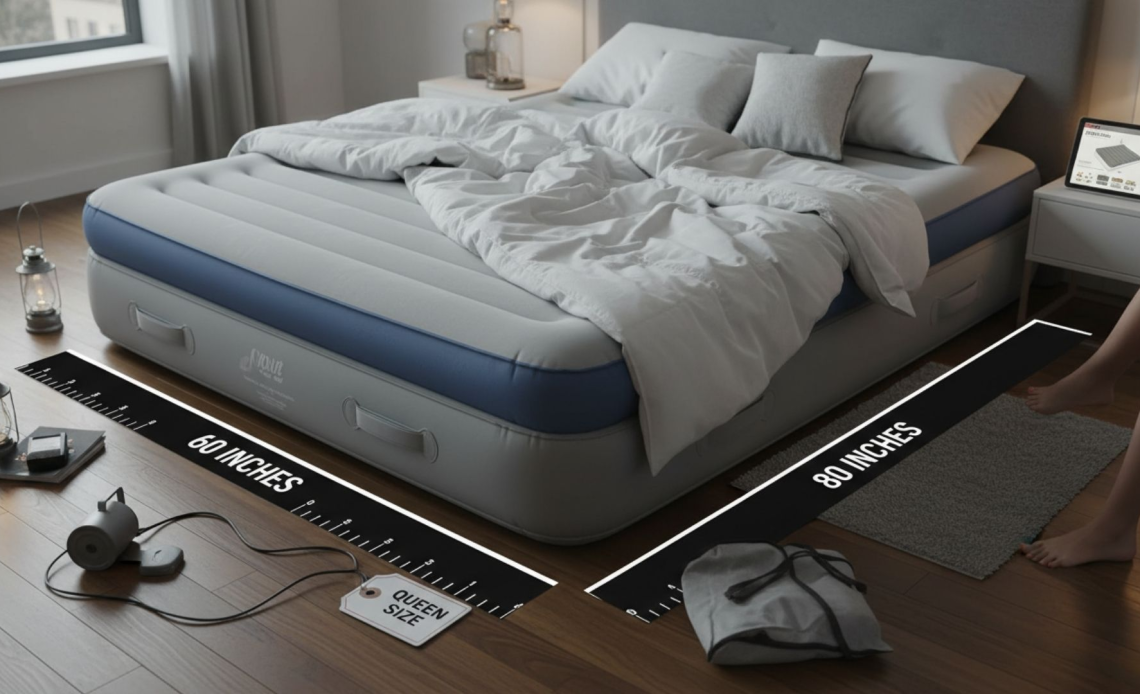
A queen air mattress is one of the most useful pieces of backup furniture you can own.
It can turn a home office into a guest room overnight, make a small apartment more flexible, and give campers a comfortable sleep without sacrificing floor space.
To get the most from it, you need to know the real dimensions, how much weight it can handle, and which features are worth paying for.
This guide walks through standard queen air mattress dimensions, how they compare with other sizes, and the key details to check before you buy.
Standard Queen Air Mattress Dimensions
Most queen air mattresses are designed to match a standard queen bed footprint so they fit regular queen sheets.
In most markets that means 60 inches wide and 80 inches long, or about 152 by 203 centimeters.
Variations of one or two inches in either direction are common. That comes down to each brand’s design, the thickness of the side walls, and whether there is an integrated headboard or raised edge.
Always check the product’s inflated size, not just the box label, if you need precise dimensions.
Read More: How To Raise An Air Mattress Off The Floor?
Height and profile options
Length and width change very little from model to model. Height is where queen air mattresses differ the most.
You will typically see three broad profiles:
- Low profile or camping style, around 8 to 10 inches high. Some basic models fall in this range and are easy to roll up, pack, and store.
- Mid profile, roughly 12 to 15 inches high. These feel closer to a standard mattress but still pack down reasonably small.
- Raised or “double height,” often 16 to 20 inches high, sometimes a little more. Several popular queen models list inflated heights of 16 to 20 inches.
A taller air mattress is easier to get in and out of, especially for older guests or anyone with mobility issues. Lower models feel more compact and are better for tents with tight headroom.
How much room does a queen air mattress need?
A queen footprint of 60 by 80 inches works well in most guest rooms, but it still needs breathing space.
Guides on queen bedroom layouts suggest that a comfortable room for a queen bed starts around 10 by 10 feet so you can move around both sides.
If you are using the mattress in a small room or studio, sketch the space or measure the floor before you order.
Leave at least 18 to 24 inches of clearance on the sides you expect people to use as a walkway, and remember to factor in a power outlet if the mattress uses a built in pump.
Queen Air Mattress Compared With Other Sizes
Understanding how a queen compares to other air mattress sizes helps you choose the right one for your situation.
A full air mattress usually measures about 54 by 75 inches. A queen at 60 by 80 inches gives you six more inches of width and five more inches of length.
That extra space makes a noticeable difference for two adults or for a taller sleeper who tends to sleep stretched out.
King air mattresses usually measure about 76 by 80 inches, which is 16 inches wider than a queen. They are great for large rooms but can feel awkward in smaller spaces.
For most people balancing comfort with floor area, a queen air mattress is the practical sweet spot. For solo sleepers who need to save every inch of floor space, a twin or twin XL air mattress may be enough.
For couples or for guests who might share the bed with a small child, a queen is usually the more comfortable choice.
Weight Capacity And Support
Every air mattress has a maximum weight rating. This is not only about safety. Exceeding that limit can strain seams, encourage leaks, and shorten the life of the mattress.
Typical guidance for queen air mattresses places their weight capacity in the 500 to 600 pound range.
That is usually enough for two adults plus a child, but you should still check the exact number given by the manufacturer. Some heavy duty models go higher, while budget mattresses may sit at the lower end of the range.
A few key points about weight capacity:
Height does not equal strength. A taller mattress is not automatically stronger than a lower one. Weight limits come from the internal structure, the thickness and quality of the vinyl or fabric, and the way seams are welded.
The internal design matters. Modern air mattresses often use air coils, beams, or multiple chambers to spread pressure more evenly.
These upgrades help the mattress support more weight without sagging, especially near the edges.
If you are buying for a heavier sleeper, or for long term use, pay extra attention to this specification and lean toward models that clearly advertise higher capacities rather than ones that do not mention a number at all.
Read More: Why Do Airbeds Lose Air Overnight? (Reasons and Fixes)
Key Features To Look For In A Queen Air Mattress
Once you are confident about dimensions and weight capacity, focus on features that make day to day use easier.
Built in pump or external pump
A built in electric pump is one of the most convenient upgrades. You plug it into the wall, turn a dial, and the mattress inflates itself in a few minutes.
This is ideal for guest rooms or temporary beds at home. Many raised queen models now include this style of pump as standard.
For camping or off grid use, look for a mattress that either uses a manual pump or has a separate pump that can run from batteries or a car outlet. A built in electric pump alone is not very helpful in a tent without power.
Surface material and comfort
Look for a soft, flocked top fabric. It feels less slippery under sheets and is more comfortable against skin if someone ends up sleeping without bedding.
The upper surface around the seams is also where small punctures are most likely, so a thicker top fabric is a practical advantage.
Internal coil or beam construction reduces the “bouncy raft” feeling and keeps two sleepers from rolling toward each other. Heavier guests will especially appreciate this added stability.
Height and edge design
For a guest bed at home, a raised queen around 18 to 20 inches high feels closest to a traditional mattress on a low platform.
Models with a slightly raised perimeter or built in headboard help keep pillows from sliding off and create a more bed like feel.
For camping, a mid height mattress may be more sensible. It still lifts you well off the ground but does not crowd the tent. A very tall mattress in a low tent can put your head uncomfortably close to the ceiling.
Durability details
Reinforced seams and puncture resistant vinyl or laminated fabric, which handle more movement without stressing the material.
An included patch kit so you can repair small leaks instead of replacing the entire mattress.
A storage bag that is large enough to hold the mattress without forcing it into a tight roll.
Even if manufacturers use different marketing terms, those are the underlying details that will make the mattress last more than a few weekends.
Tips For Setup And Sizing
Measure the space where you plan to use the queen air mattress and mark out the 60 by 80 inch footprint on the floor with painter’s tape.
Walk around it as if the bed were already there. This simple test prevents surprises when guests actually arrive.
Place the mattress on a smooth, clean surface, never directly on rough concrete or sharp floorboards. A thin rug, tarp, or mattress protector underneath can dramatically reduce the risk of punctures.
Use standard queen fitted sheets and, if the mattress will be used more than a night or two, add a mattress topper or pad. This softens the feel and adds a layer between sleepers and the vinyl surface.
When you first inflate the mattress, expect a little softening as the material stretches. Top it up just before bed for best comfort.
In colder rooms or outdoor settings, air contracts and the mattress will feel softer by morning. A quick top up solves this.
Deflate and fold the mattress slowly rather than forcing the air out. Avoid hard creases in the same place every time.
A looser roll and a slightly larger storage bag are far better for long term durability than an aggressively tight package.
Read More: Best 8 Sofa Bed Mattresses
Conclusion
A queen air mattress gives you generous sleeping space in a footprint that suits most rooms and tents.
Once you understand that the typical size is about 60 by 80 inches, know the height and weight capacity you need, and choose the right pump and surface features, it becomes much easier to pick a model that actually feels like a real bed.
With a little care in setup and storage, a good queen air mattress can serve guests, campers, and you for many nights of comfortable sleep.