
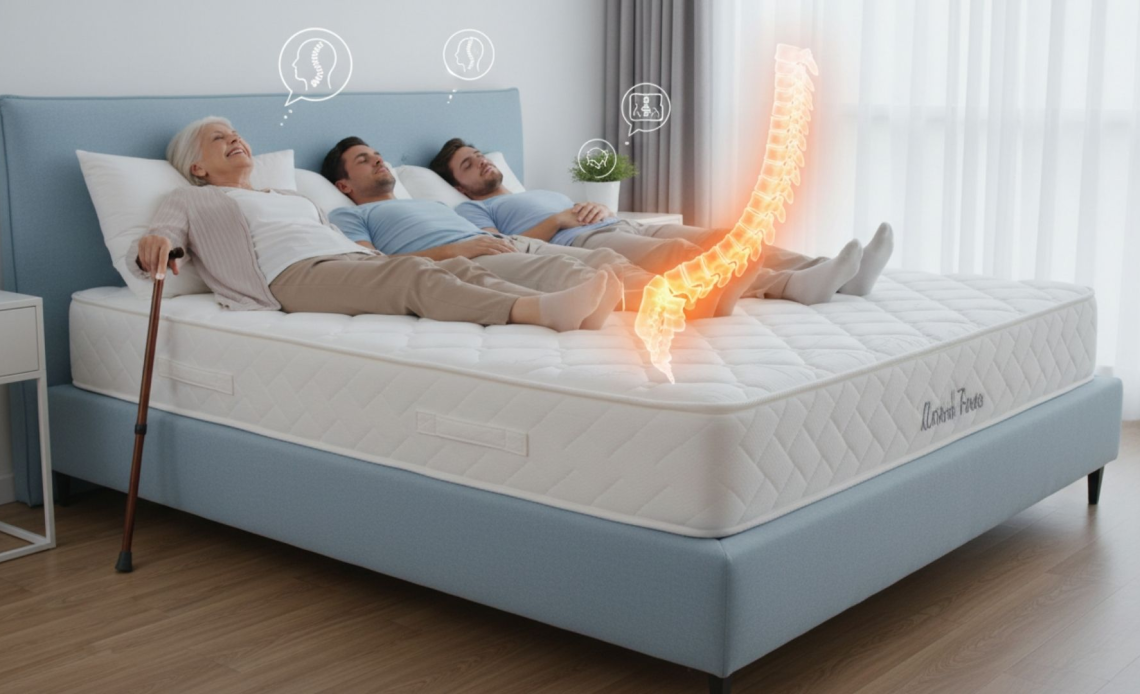
Walk through any mattress store today and you will see the word orthopedic everywhere. It sounds medical, reassuring, and very serious about your back.
The trouble is that most shoppers are not sure what the term actually means or whether they genuinely need this type of mattress.
This guide cuts through the marketing and explains what an orthopedic mattress really is, what current research says about mattresses and back pain, who should consider buying one, and how to choose the right model for your body rather than just the label on the box.
What Is an Orthopedic Mattress?
In simple terms, an orthopedic mattress is designed to support your spine’s natural alignment, distribute body weight more evenly, and reduce pressure on joints while you sleep.
Instead of focusing mainly on plush softness, it prioritizes stable, well structured support so your back can rest in a neutral, healthy position.
The name comes from orthopedics, the medical field that deals with bones, joints, muscles, and the spine.
In a good orthopedic mattress, the goal is not to straighten your back but to keep its natural curves in place so that your muscles do not have to work all night to hold you up.
A crucial detail many people do not realise in most countries orthopedic mattress is not a strictly regulated medical term.
Manufacturers can use it quite freely. That means you have to look beyond the label and focus on how the mattress is built and how it feels to your body.
Read More: Best 8 Sofa Bed Mattresses
Key Design Features
While designs differ across brands, genuine orthopedic models tend to share a few traits.
They usually sit in the medium firm to firm range, with a support core that does not sag under your hips and lower back.
This core may be made of high density foam, latex, pocket springs, or a combination of these.
On top of the core, there are comfort layers that contour slightly to your shoulders and hips so pressure does not build up at these bony points.
Many modern orthopedic mattresses also use zoned construction, where certain areas are firmer or softer.
For example, the lumbar zone under your lower back may be reinforced, while the shoulder zone allows a little more sink for side sleepers.
This zoning aims to keep your spine closer to a neutral line whether you lie on your back or side.
On top of support, brands often add features such as motion isolation for couples, breathable covers, and hypoallergenic materials.
These are not uniquely orthopedic, but they can make the mattress more comfortable for everyday use.
Orthopedic vs Regular Mattresses
A regular mattress might feel comfortable at first yet allow your hips to sink too deeply or leave a gap under your lower back. Over time, this can encourage poor spinal alignment and muscle tension.
Orthopedic mattresses are engineered to avoid those extremes.
Instead of very soft cushioning, they aim for a balance between contouring and pushback so your spine is supported in roughly the same way it would be if you stood with good posture.
The word on the label is not a guarantee. There are excellent supportive mattresses without the orthopedic tag, and there are also orthopedic models that are simply hard and uncomfortable.
Research suggests that extremely hard beds can actually worsen pain for some people, whereas medium firm surfaces tend to perform better for comfort, sleep quality, and spinal alignment.
Read More: 10 Best Sleeper Sofas & Sofa Beds
What Does Science Say About Mattresses and Back Pain?
Back pain is complex. It can come from discs, joints, muscles, nerves, or a mix of all of these, influenced by posture, stress, activity levels, and weight.
No mattress can cure serious spinal disease, but it can make symptoms easier or harder to live with.
A widely cited review of clinical studies found that medium firm mattresses were associated with better comfort, sleep quality, and alignment of the spine compared with very soft or very hard options.
Another study that surveyed orthopedic surgeons reported that almost all believed mattress choice plays a role in managing low back pain, although many still recommended very firm surfaces.
Later research has challenged the idea that harder is always better and instead points toward supportive but slightly yielding designs.
There are also experimental mattresses that use special foams, traction zones, or adjustable air chambers to change how your spine is loaded during the night.
Some small studies show improvements in pain and function for certain designs, but overall the evidence is still limited and results vary between individuals.
The takeaway is that your mattress matters, but there is no one perfect model for everyone.
Orthopedic mattresses are one class of supportive bed that can help many people with pain, especially when chosen carefully to match body type and sleep position.
Who Should Consider an Orthopedic Mattress?
You do not need to be under a doctor’s care to benefit from an orthopedic mattress. But there are clear situations where this style makes more sense than a basic, very soft bed.
If you live with chronic low back pain, neck pain, or general stiffness on waking, a mattress that holds your spine closer to neutral alignment can reduce overnight strain and morning soreness.
Many people with conditions such as arthritis, fibromyalgia, or scoliosis also report better sleep when they have more even weight distribution and fewer pressure points.
Older adults often lose muscle mass and natural cushioning with age.
For them, an orthopedic mattress can provide firmer underlying support while still offering enough comfort at the surface, which helps reduce tossing and turning from pressure pain in the shoulders, hips, and knees.
People who are heavier than average may also benefit, since softer mattresses can compress too deeply under higher body weight.
A well built orthopedic model with a dense support core is less likely to sag and can help keep alignment more stable through the night.
If you consistently wake up feeling more tired and achy than when you went to bed, or you notice that hotel beds or friends’ slightly firmer mattresses leave you feeling better, that is another sign that it might be time to upgrade to a more supportive surface, orthopedic or otherwise.
Who Probably Does Not Need One
On the other hand, not everyone needs an orthopedic mattress, at least not urgently.
If you are young, active, currently pain free, and already sleep well on a decent quality medium firm mattress, switching just for the label may not make a noticeable difference.
For many side sleepers, a very firm orthopedic model without enough cushioning at the top can actually increase shoulder and hip discomfort, especially in lighter bodies.
Likewise, if your pain clearly comes from an acute injury, poor work posture, or lack of movement during the day, a new mattress alone is unlikely to solve the whole problem.
It can be part of the solution but not a replacement for exercise, ergonomics, or medical care.
Read More: How To Inflate an Air Bed?
How To Choose the Right Orthopedic Mattress?
If you decide to look at orthopedic options, treat the label as a starting point, not a decision.
Start With Your Body and Sleep Position
Side sleepers usually need more pressure relief around the shoulders and hips so that the spine stays fairly straight from neck to tailbone when viewed from behind.
Back and stomach sleepers often do better with slightly firmer support that stops the pelvis from sinking too far.
Lighter people generally feel mattresses as firmer, while heavier people compress them more, which effectively softens the feel.
Before shopping, note your primary position, approximate weight, and whether you share the bed. All of these influence which orthopedic design will feel supportive rather than harsh.
Check Firmness, Not Just the Name
Look for clear information on firmness and materials. Many experts now suggest medium firm as a sensible starting point for people with back pain, since this level often offers a good compromise between support and comfort.
Check whether the mattress uses zoned support, what density its foams have, and whether there are reinforced edge or lumbar areas.
These details often tell you more about performance than the marketing description.
Use Trials and Simple At Home Tests
If the brand offers a trial period, use it. When the mattress arrives, lie in your usual sleep position and ask someone to snap a picture from the side.
Your spine should look roughly straight if you lie on your side, or maintain gentle natural curves if you lie on your back. If your hips dip or your shoulders are forced up, the mattress is not supporting you correctly.
Pay attention to how you feel in the morning, not just during the first ten minutes. Mild adaptation is normal, but worsening pain over several weeks usually means something about the firmness or zoning is off for your body.
Pros and Cons of Orthopedic Mattresses
The major advantages are better spinal alignment, more even weight distribution, reduced pressure on painful joints, and often improved sleep quality for people with existing musculoskeletal issues.
Many orthopedic models also use durable materials that resist sagging, so they maintain their support for longer than very soft, low density beds.
On the downside, orthopedic mattresses typically cost more than basic options, especially those with advanced foam or spring systems.
Some people find them too firm or clinical at first, particularly if they are used to deep, plush cushioning.
And because the term is not tightly regulated, you must be careful to distinguish genuinely supportive designs from simple hard mattresses that are sold under a medical sounding label.
When To Talk To a Doctor First
If you have severe or worsening back pain, pain that travels down your leg, weakness, numbness, unexplained weight loss, or changes in bladder or bowel control, speak to a doctor before relying on a mattress upgrade.
These can be signs of serious underlying conditions that need proper diagnosis.
Once your doctor has ruled out urgent problems or started treatment, an appropriate mattress can become part of your long term management plan, alongside exercise, physical therapy, and lifestyle changes.
Read More: What Are Comfortable Air Mattress Alternatives?
Conclusion
An orthopedic mattress is not magic, but it can be a valuable tool if your current bed leaves you sore, stiff, or poorly supported.
Think of it as a carefully engineered sleep surface that aims to keep your spine in a healthy position and reduce unnecessary pressure on joints and muscles.
You are most likely to benefit if you already have back or joint pain, are older or heavier, or notice that you sleep better on slightly firmer, more supportive beds.
Choose based on firmness, construction, and how your body feels over several weeks, not just the word orthopedic on the label.
Invest wisely and your mattress will not just be a place to crash at the end of the day, but a quiet partner in keeping your spine healthier for years to come.