
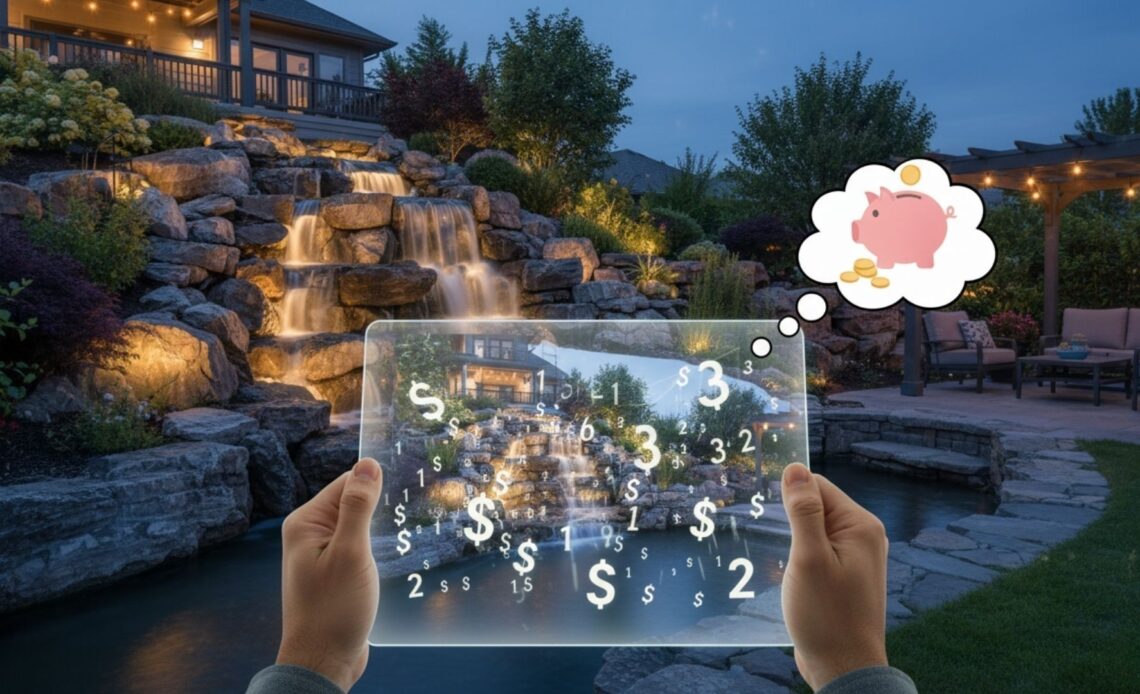
A backyard waterfall changes the entire mood of a garden. The sound softens street noise, the movement catches the light, and the whole space feels more intentional. Before you get carried away dreaming of rock and water, though, you need a realistic budget.
A professionally installed outdoor waterfall will land somewhere between about $4,000 and $20,000.
Simple pondless systems at the small end may start just under that, while long, multi level streams with heavy stonework can push far beyond $20,000 into truly custom territory.
The wide range comes from your design choices. A small DIY kit tucked beside a patio is a very different project from a large naturalistic waterfall that spills into a koi pond.
This guide walks through typical price ranges, what drives them, and the ongoing costs so you can plan with clear numbers, not guesswork.
Typical Cost To Install an Outdoor Waterfall?
Pondless waterfalls
Most new residential waterfalls today are pondless. Water flows over rock and disappears into a hidden underground basin, then recirculates through a pump. For many homeowners, this hits the sweet spot between drama and maintenance.
National cost guides and installer pricing show:
- Entry level professional pondless waterfalls often start around $4,000 to $6,000 for a short run of stream and a simple cascade.
- A common mid range build, with roughly a 10 to 20 foot stream and several drops, frequently ends up in the $8,000 to $20,000 bracket.
- Larger or more intricate projects, with tall falls, long streams, or elaborate rock outcroppings, can easily climb from $20,000 up to $50,000 and beyond.
Several pond builders also describe full cost ranges for pondless waterfalls from roughly $5,000 at the smallest scale to $25,000 or more once you add length, height, stone, and landscaping.
If you are budgeting for a typical professionally installed pondless waterfall, planning on roughly $7,000 to $15,000 will cover many average suburban projects.
Waterfalls with a pond
If you want a pond at the base for fish or plants, plan on a higher investment.
Landscape companies that specialize in water features often quote:
- Small to medium ponds with a waterfall, in the 50 to 5,000 gallon range, around $15,500 to $35,000, depending on size and add ons such as lighting or streams.
- Large specialty ponds designed for fish or as recreation features, with substantial waterfalls and streams, starting near $60,000 and rising from there.
One detailed pond pricing guide reports backyard ponds ranging from about $9,000 for a small basic build to around $95,000 for a large, fully landscaped system with multiple waterfalls and wetlands filtration.
Read More: Fibreglass Pools: A Durable and Low Maintenance Choice for Your Backyard Oasis
DIY kits and partial DIY builds
If you are handy, DIY can trim the budget, especially for compact features.
Garden and pondless waterfall kits for small streams or spillways commonly range from about $400 at the smallest scale to roughly $1,500 or more for complete packages that include basin, liner, and pump.
Home and garden sources that priced out larger DIY waterfall kits found many in the $600 to $4,000 range, depending on length, pump size, and whether you bring in help for parts of the build.
One cost comparison example shows a medium pondless waterfall kit at about $3,500, while a similar professionally installed feature lands near $8,000.
That gives a useful rule of thumb: once you add excavation, heavy stone placement, expert design, and warranty coverage, a professional build may cost roughly two to three times the kit price.
What are the main Factors That Affect Waterfall Cost?
Exactly where your project falls within those ranges comes down to a handful of levers you can actually control.
1. Type and size of the feature
The first decision is whether you want a pondless waterfall or a waterfall that spills into a pond.
Pondless designs are usually more affordable because they need less excavation, no deep basin, and a smaller volume of water and liner.
Several installers highlight pondless waterfalls as more cost effective than traditional ponds with similar visual impact.
Within each type, size drives cost more than anything else. A 4 foot long pondless waterfall with a small drop needs only modest rock, liner, and pump capacity.
Stretch that stream to 16 or 20 feet with multiple cascades and you add tons of stone, more liner, a larger pump, and many more hours of labor, which is why some companies price long custom streams at $20,000 to $50,000 or more.
2. Design complexity and materials
Two waterfalls can be the same length and still fall in very different price brackets.
Natural boulders cost more than small river rock. Tall, stacked stone spillways require more labor than a single prefab spillway box.
Custom concrete rockwork, grottos, viewing caves, and integrated seating areas push the design into high end territory.
Lighting, advanced filtration, automatic top off systems, and smart pump controls also add to the bill. Ponds that must support fish need more robust filtration and sometimes additional circulation, which means more equipment and plumbing.
3. Site conditions and access
Your yard can quietly add thousands of dollars.
A flat, open lawn near a driveway is simple. A steep slope, tight side yard, or area behind a house with no machine access means more hand work, more soil moving, and more time.
Rocky or root filled soil, or a location where utilities must be worked around, can raise excavation and preparation costs.
These challenges show up on detailed cost breakdowns as higher installation labor and site preparation lines.
4. Local labor rates and contractor expertise
Water features are a specialized craft. Designers and crews who focus on ponds and waterfalls charge accordingly, especially when they stand behind their work with a warranty.
In areas with higher labor and business costs, the same size waterfall naturally comes with a higher price tag. That is one reason online ranges can look wide.
A 10 foot pondless waterfall that costs around $10,000 in one region might be several thousand dollars more in another.
Read More: Backyard Zen Garden Concepts for Compact Spaces
Where Your Money Goes?
Even if you never see a line item estimate, most waterfall projects break into similar buckets.
Hardware and liner
At the heart of any waterfall are the pump, intake or skimmer, spillway or waterfall box, flexible plumbing, underlayment, and liner. For pondless features, add the basin or reservoir components and any vault that houses the pump.
For small to medium pondless waterfalls, complete hardware and liner packages often account for several thousand dollars of the finished price.
DIY cost ranges for kits in the $1,000 to $7,500 bracket give a good feel for what these components cost before labor.
Stone and structural work
Rock is both structure and finish. Big fieldstone or ledgestone boulders anchor the waterfall, hide equipment, and create the falls.
The heavier and more numerous the rocks, the more expensive both materials and placement become.
Some builders describe mid sized pondless waterfalls using 8 to 10 tons of stone, which helps explain why long streams and tall falls rise quickly in price as you add vertical height and complexity.
Excavation, installation, and plumbing
Digging the basin, shaping the stream, setting the liner, and installing the pump and piping all fall into labor and equipment time.
The cost breakdown for a pondless waterfall assigns separate line items to excavation, installation labor, and plumbing, with installation alone ranging from $1,000 to $2,500 for smaller projects and higher for complex builds.
If electricians need to install or extend a GFCI outdoor outlet or run new wiring, that work is usually billed separately.
Surrounding landscaping and finish work
The last part of the budget is the one you enjoy every day: planting pockets, mulch or rock groundcover, edging, and sometimes adjacent patios or paths.
Landscaping around a waterfall can add many hundreds or several thousand dollars, particularly when you include new plantings, sod repair, or hardscape add ons.
Running and Maintaining a Backyard Waterfall
Planning only for installation is a mistake. Waterfalls are ongoing features, and they do have carrying costs.
Electricity for the pump
The pump usually runs continuously during the season, so electricity is the main ongoing cost.
A pump energy guide shows that running a 50 watt pump all day, every day, costs roughly $44 to $153 per year depending on how expensive electricity is where you live, while a 100 watt pump doubles that to about $88 to $263 per year.
Many decorative waterfalls use pumps in the 50 to 150 watt range, while larger ponds and high flow features may use bigger pumps or multiple pumps.
A backyard pond cost study that examined different systems found annual electricity costs ranging from just a few dollars for very small, efficient setups to more than $600 for large ponds with powerful pumps.
The takeaway: for a typical residential waterfall, it is wise to budget at least tens of dollars per year for electricity, and for larger or fish supporting systems, potentially a few hundred.
Read More: Backyard Styling Made Easy: 5 Tips for a Stunning Outdoor Space You’ll Love
Water use
Because water recirculates, you are not paying for a constant fresh supply. You do, however, lose water to evaporation and a bit of splash.
In warm, dry climates that can mean topping up the system regularly. The actual cost depends on your local water rates and climate, but for most homeowners it is modest compared with the electricity.
Routine maintenance
Even pondless waterfalls need care. Expect to:
- Clear leaves and debris from the intake or skimmer basket
- Rinse or replace filters and filter media on a schedule recommended for your system
- Check and occasionally adjust rocks or foam where water may be escaping the liner path
Pondless systems avoid the fish care, algae control, and deeper cleaning that come with full ponds, which is one reason they are often marketed as lower maintenance and more cost effective to operate than traditional ponds.
You should also plan on eventual pump replacement, typically after several years of service, which might be a few hundred dollars depending on the model.
How To Plan Your Budget And Save?
A waterfall is a luxury feature, but there are smart ways to keep the numbers in line with your comfort zone.
Start by deciding whether you truly need a pond. If your goal is the sound and movement of water near a seating area, a pondless waterfall is usually less expensive to build and simpler to live with than a pond with fish.
Next, match the size of the feature to your yard and to where you spend time. A compact waterfall closer to your patio often delivers more enjoyment than a huge waterfall tucked at the back of the property. Smaller scale also keeps hardware, stone, and labor costs down.
If your yard has a natural slope, use it. Building into an existing grade typically needs less soil moving and structural work than creating a tall mound from a flat lawn, which can lower both material and labor costs.
When you request quotes, ask contractors to spell out what is included: design, excavation, liners and hardware, rock, electrical work, planting, and cleanup. Use that detail to compare like with like, not just total numbers. Look closely at the warranty, too, since a slightly higher upfront cost may cover future repairs.
Consider a hybrid approach. Many homeowners hire professionals for the critical parts such as design, excavation, liner installation, rock placement, and pump setup, then handle surrounding planting and finishing touches themselves. That can keep the structure sound while trimming the total.
Read More: 10 Creative Ideas for Designing Your Dream Backyard Oasis
Conclusion
There is no single price tag for an outdoor waterfall. For some homeowners, it is a $1,500 weekend kit project. For many, it is a professionally built pondless waterfall in the $7,000 to $15,000 range.
It is a major landscape investment of $20,000 to $50,000 or more, especially when a large pond and extensive stonework are involved. What matters is aligning the feature with your budget and the way you actually use your yard.
Once you understand how size, type, materials, and site conditions pull the budget up or down, you can shape a design that gives you the sound and movement of water you want without unpleasant surprises when the quote arrives.