
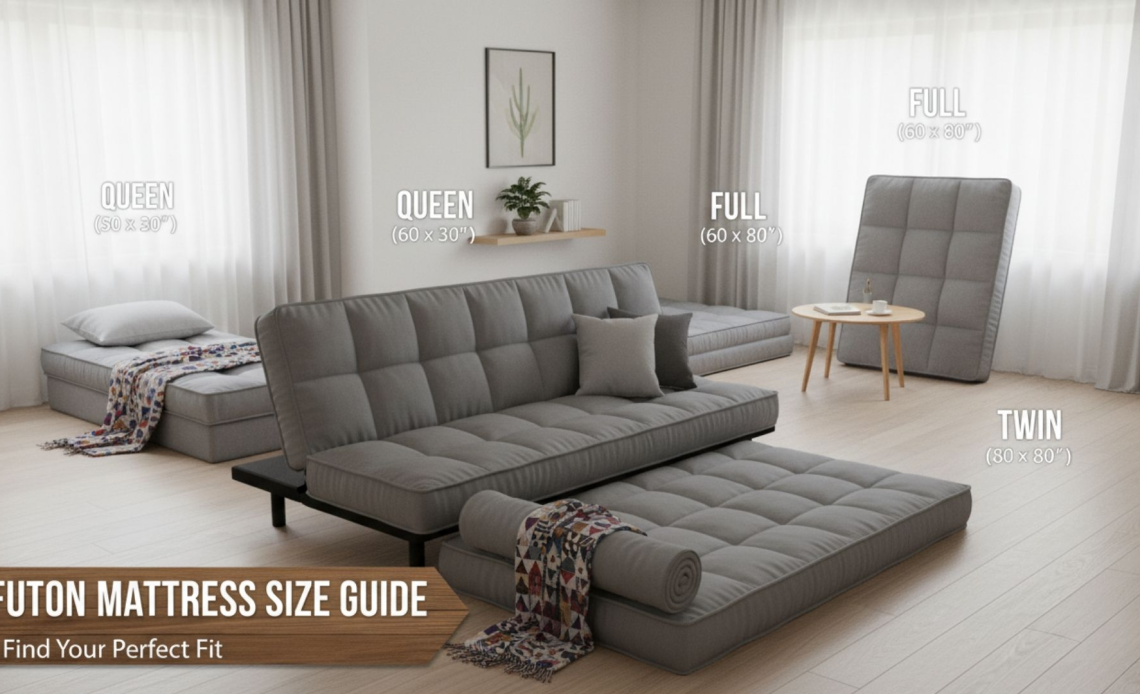
A futon can be a sofa, a guest bed, a permanent bed, or a roll up mattress that lives in a closet. That flexibility is exactly why futon sizing feels confusing.
Labels like twin, full, queen or single, semi double, double look familiar, yet actual dimensions and thickness vary more than with regular mattresses.
This guide walks through standard futon mattress sizes for both Western style futon sofas and traditional Japanese floor futons, with practical advice on which size works best for your room, your body, and how you plan to use it.
Decide Which Type of Futon You Need
Before you worry about numbers, be clear about the kind of futon you are shopping for.
Western futon sofa mattresses sit on a wood or metal frame that folds from couch to bed.
Most follow classic mattress labels such as twin, full, queen and sometimes king. They are thicker and more padded so they can handle daily sitting as well as sleeping.
Japanese floor futons, or shikibuton, are thin cotton filled mattresses designed to sit directly on tatami or on the floor.
They are usually folded and stored each day, which keeps the room clear and lets the futon air out.
In Japan, common sizes are single, semi double and double, measured in centimeters rather than inches.
Once you know which camp you are in, the size choices start to make sense.
Read More: Orthopedic Mattress: What It Is and Who Should Buy It?
Standard Futon Mattress Sizes
Most Western style futon mattresses follow familiar bed dimensions, although some brands trim a little from the length or width so the mattress folds more cleanly inside the frame.
Twin futon
A twin futon mattress is usually about 39 inches wide and 75 inches long. This size works well for:
- narrow home offices or box rooms that need a single guest bed
- kids rooms, where floor space for play matters as much as the bed
- daybeds and lounger style frames
For adults over about six feet tall, a standard twin may feel short. If the frame supports it, a twin extra long futon mattress around 39 by 79 or 80 inches is a better match for height.
Full futon
The full or double futon mattress is one of the most common sizes, around 54 inches wide and 75 inches long.
Full size futons are ideal if you:
- sleep alone and like extra room to move
- want a sofa that opens into a real bed for guests
- live in a small apartment with limited wall space
Two adults can share a full futon for a night or two, but it often feels tight for long term use, especially if the mattress is on the firmer side.
Queen futon
A queen futon mattress is typically 60 inches wide and 80 inches long, and it is the go to size for couples in many futon sofa lines.
Choose queen if you:
- want a couch that functions as a true shared bed
- are tall and need extra length
- have a larger living room or studio and can spare more wall space
Queen futon frames need a little more clearance in front when opened, so always check the fully flat dimensions against your room.
King and specialty futon sizes
King and California king futon mattresses exist, usually with dimensions that mirror standard beds, such as 76 by 80 inches for king or 72 by 84 inches for California king.
They are far less common, often special order and better suited to dedicated futon bed frames than to convertible sofas.
You may also run into chair futons or loveseat futons that use non standard sizes. In that case, trust the measurement on the frame label rather than the name.
Japanese Futon Sizes in Centimeters
Traditional Japanese futons are sized for tatami layouts, so the dimensions look different at first glance. Many brands cluster around a similar set of measurements.
Typical shikibuton lengths are about 200 to 210 centimeters, close to 79 to 83 inches, with width varying by size.
Common sizes include:
- Single around 90 to 105 by 200 centimeters
- Semi double around 120 by 200 centimeters
- Double around 140 by 200 centimeters
Some makers also offer queen shikibuton at about 150 by 200 centimeters, and a few produce king options near 180 by 200 centimeters, although large futons are heavier and harder to fold, so they are less popular.
Couples who want a traditional setup often place two single futons side by side rather than buying one very large piece. This makes daily handling easier and gives each person the freedom to adjust firmness or layering.
If you are pairing a Japanese futon with a Western bed frame, measure the inside platform dimensions carefully.
Some shikibuton are cut to fit Japanese mattress standards, which differ slightly from United States sizes.
Read More: What Are Comfortable Air Mattress Alternatives?
How Deep Should a Futon Mattress Be?
Size is only half the story. Thickness and fill have a big impact on comfort, and they differ sharply between sofa futons and floor futons.
Thickness for Japanese floor futons
Shikibuton are intentionally thin and firm so they can air out and roll away. Many brands describe their futon mattresses as around 3 to 4 inches thick, or roughly 8 to 10 centimeters.
A thinner futon feels firmer and closer to the floor, which some sleepers prefer for spinal alignment.
Slightly thicker options add cushioning but are heavier to lift and may take longer to dry.
You can also layer a topper over a standard shikibuton to tune the feel without buying a very thick base.
Thickness for Western futon sofas
Convertible futon mattresses that double as couches are usually much deeper. Retailers commonly sell futon mattresses in ranges from about 6 to 8 inches, and premium models climb to 10 or even 12 inches.
Medium thickness futons in the 6 to 8 inch range often provide the best balance for a sofa bed.
They are substantial enough for adults to sleep on, but not so thick that folding the frame becomes awkward.
Thicker models can feel more mattress like when flat, yet they are heavier to move and may look bulky in the upright position.
If you plan to sleep on a futon every night, lean toward the thicker end of what your frame can handle and choose a build that combines foam and cotton or foam and coils for better long term support.
Frame, Room and Bedding
Even when you know the label size, a good futon fit is all about measurements. For Western futon sofas, manufacturers often recommend measuring the back deck of the frame.
A full futon mattress around 54 by 75 inches typically needs a deck width of roughly 72 to 75 inches, while a queen mattress of 60 by 80 inches fits frames with a back width of about 77 to 80 inches.
Always compare the mattress dimensions on the product page with the frame specifications.
Futon mattresses sometimes run slightly smaller than standard bed mattresses so they can sit neatly in the frame crease when folded.
In tight rooms, also check:
- Clearance in front of the frame when it opens fully
- Space to walk around the ends
- Door swing and any nearby storage or radiators
If the futon will live in a studio or small living room, a full size mattress often strikes the best balance between seating space and open floor.
In a dedicated guest room where the futon spends more time flat, a queen size mattress feels more like a traditional bed.
For Japanese floor futons, think about storage as much as floor area.
A double shikibuton around 140 by 200 centimeters needs a closet or wall space long enough to store it without over folding, plus room to hang it to air regularly.
If your storage is limited, two single futons may be more practical than one large piece.
Read More: Mattress Pad Vs Mattress Protector
Quick Checklist Before You Buy
Before you commit, run through a short mental checklist.
- Who will sleep on the futon most of the time, and how tall and heavy are they
- How often it will be used for sleep versus sitting
- Whether you need it to fold on a frame or roll up for storage
- The exact floor or frame dimensions where it has to fit
- How much thickness your frame, closet or body can realistically handle
Answering those points will usually point you toward a specific combination. For example, a city studio for two people often ends up with a queen futon sofa around 60 by 80 inches and a mattress in the 8 inch range.
A minimalist spare room that doubles as a yoga space may work better with a semi double shikibuton around 120 by 200 centimeters that folds neatly into a wardrobe.
Conclusion
Choosing futon size is really about matching three things: your body, your space and how often you plan to sleep on it.
Western futon sofas follow the same basic twin, full and queen ladder as regular beds, with full and queen dominating the market.
Japanese shikibuton follow a different naming system and lean on compact, easy to handle sizes that are meant to be folded and stored.
Once you understand how those two worlds map out, the numbers stop being intimidating and become another tool you can use to shape a room that works the way you live.
Measure carefully, think about thickness as well as length and width, and your futon mattress will feel less like a compromise and more like a custom fit.