
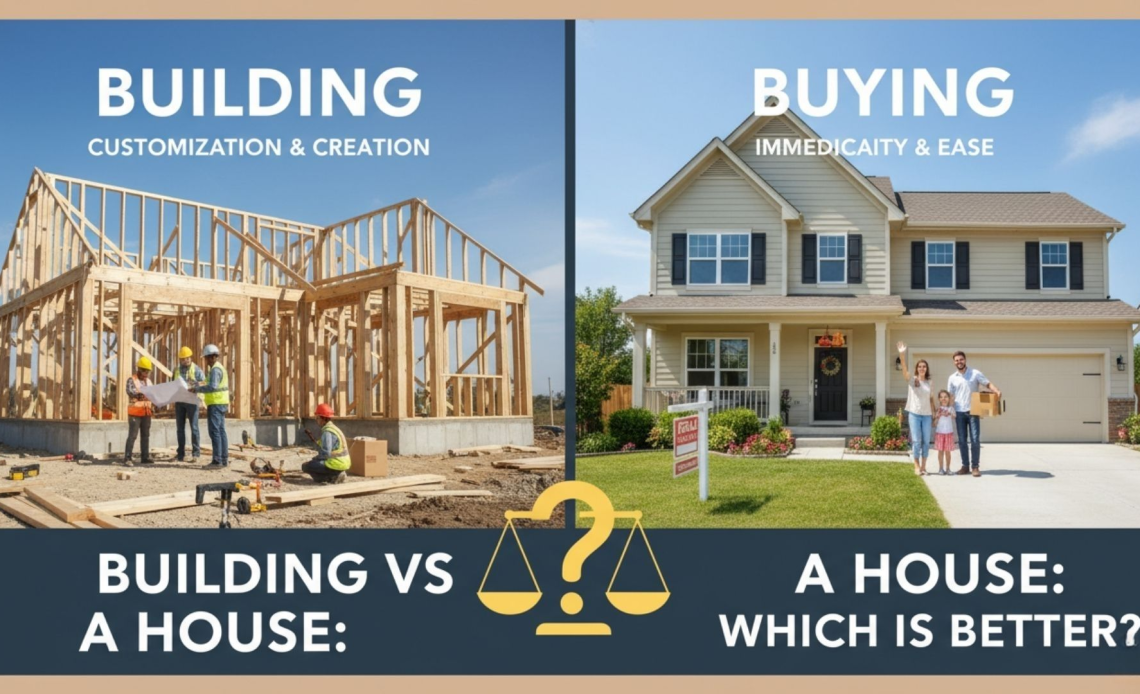
Deciding where to live is hard. Deciding whether to build that home from scratch or buy one already standing can feel even harder.
Both paths can get you to a place you love, but the money, timing and stress level look very different.
There is no universal winner. The better choice is the one that fits your budget, timeline, local market and appetite for uncertainty.
Let’s walk through what really changes when you build versus buy so you can make a clear, grounded call.
The Money Side
What It Really Costs To Build
When people say building is cheaper, they are usually talking about the house alone, not the full project. That distinction matters.
Recent national construction surveys put the average cost to build a typical new single family house in 2024 at about 428,000 dollars, or roughly 160 dollars per square foot of finished space.
That figure covers materials and labor for the structure itself but not the land.
Once you add:
- land purchase
- site work and utilities
- permits and impact fees
- design, engineering and surveys
- a general contractor’s overhead and profit
the all-in cost climbs. Some estimates that include a typical contractor markup suggest closer to about 195 dollars per square foot on average, again before upgrades or unusual site conditions.
On top of that is financing. Construction loans often have higher interest rates than standard mortgages, and you may be paying interest on the build while still paying rent or a current mortgage.
The upshot: building gives you more control over where each dollar goes, but the final cost is harder to predict and easier to overshoot.
What Does It Really Cost to Buy?
Buying an existing home looks simpler on paper. There is a list price, you negotiate, you close. But it helps to understand the baseline numbers.
Recent national data shows the median existing home price at the end of 2025 was just over 405,000 dollars across all housing types, with single family homes a little above 409,000 dollars.
Online brokerage data for late 2025 puts the typical sale price in a similar band, around the mid-400,000s.
You still need to budget for:
- closing costs and prepaid taxes and insurance
- immediate repairs or safety fixes
- renovations to make the home suit your taste
Unlike a custom build, the price you agree at closing is usually the price you pay. There can be surprises inside the walls, but you are not dealing with open-ended construction invoices.
The upshot: buying generally offers a more predictable sticker price and simpler financing, but you may inherit someone else’s deferred maintenance and design choices.
Read More: Buying Property For The First Time: Complete Beginner Guide
The Case For Building Your Own Home
Custom Layout, Finishes And Features
If you have a very specific vision for how you want to live, building is the only reliable way to get it. You can design for:
- multi-generational living with a first floor suite
- a true work-from-home office with sound separation
- wider doors and step-free entries for aging in place
- oversized kitchen, pantry and mudroom for a big household
You would have to gut and reconfigure major areas to get the same result. By the time you buy, demo and rebuild, in some markets it truly is more efficient to start from scratch.
New Systems And Lower Upkeep
A new build means new roof, new wiring, new plumbing, new mechanicals and up-to-date framing and insulation.
For the first several years, your repair costs should be minimal compared with a 30 or 40 year old house that may be due for a roof, HVAC and windows all within a decade.
Most builders also provide a written warranty that covers major structural elements and certain systems for a defined period. That does not remove all risk, but it gives you a structured path if something fails early.
Energy Efficiency And Future Resale
Recent building codes and energy standards have pushed new homes toward better insulation, tighter envelopes and more efficient heating and cooling.
That can mean noticeably lower utility bills compared with an older home of similar size, especially if you add solar readiness or advanced HVAC equipment.
When you eventually sell, buyers may pay a premium for a relatively young, efficient property with modern wiring, finishes and floor plan. That can help offset some of the higher upfront cost of building.
The Case For Buying An Existing Home
Speed And Certainty
Buying usually wins on timing. Recent analysis of Census data suggests that building a new single family home takes roughly 9 to 10 months on average from permit to completion, and custom builds can easily stretch past a year.
By contrast, once your offer on an existing home is accepted, you can often close in 30 to 60 days. If you need to move for a job, school calendar or family reasons, waiting a year for construction simply may not be realistic.
Buying also provides more certainty. You walk the property, hire an inspector, review disclosures and see what you are actually getting before you commit.
A builder can show you plans and model homes, but the finished product is still a bit abstract until the last nails are driven.
Established Neighborhoods
Existing homes are often in mature neighborhoods with tree cover, parks, sidewalks, transit access and nearby shops already in place.
Zoning around you is mostly built out, so you have a better sense of what the area will feel like long term.
New builds are frequently located in developing subdivisions or on previously unused land. Sometimes that is a plus: you may get quieter streets, brand-new schools or a planned clubhouse.
Other times, you are living through years of construction traffic and waiting for basic retail to arrive.
Room To Negotiate
Buyers have recently been able to negotiate more on existing homes, whether on price, closing costs or repairs after inspection.
While builders do negotiate, they are also juggling their own construction financing, sales targets and appraisal concerns.
Instead of lowering prices, they may prefer to offer design upgrades or rate buydowns, which are useful but less flexible than cash off the purchase price.
Read More: Step-By-Step Guide To Building Your Own Home
Hidden Trade-offs People Forget To Weigh
Financing And Cash Flow
With a standard home purchase, you arrange one long-term mortgage. You may put down less than 20 percent and you know your payment schedule from the start.
Building often involves:
- a land loan or cash purchase of the lot
- a construction loan with interest-only payments during the build
- then a refinance into a permanent mortgage at completion
If construction runs long or overruns the budget, you are the one bridging the gap. That can mean paying rent or a current mortgage while also servicing construction loan interest for months longer than expected.
Time, Stress And Decision Fatigue
Building is a project, not a transaction. You will be making hundreds of decisions about layout, finishes, fixtures, appliances and site details.
Even with a good builder and a designer, you will be approving changes, answering questions and dealing with trade delays.
Some people thrive on that level of involvement and love visiting the site each week. Others find it exhausting, especially if they already have demanding jobs or young children. Be honest about your bandwidth.
Risk Tolerance And Personality
No matter how carefully you plan, building carries more variables. Material costs can rise, permitting can stall, weather can delay exterior work and a key subcontractor can fall behind schedule.
If uncertainty keeps you up at night, a well inspected resale home may suit you better.
If you are comfortable with a moving target and can roll with setbacks as long as the end result is right, building can be deeply satisfying.
Read More: Eco-Friendly Home Building Ideas For Modern Homes
Conclusion
Neither building nor buying is inherently better. They simply solve different problems. If you are clear about your money, your timing and how you handle uncertainty, the right choice usually reveals itself.
Talk with a local real-estate agent, a lender and at least one reputable builder before you decide.
They can help you understand how these trade offs look in your specific area so that when you finally get the keys, you also get peace of mind.
