
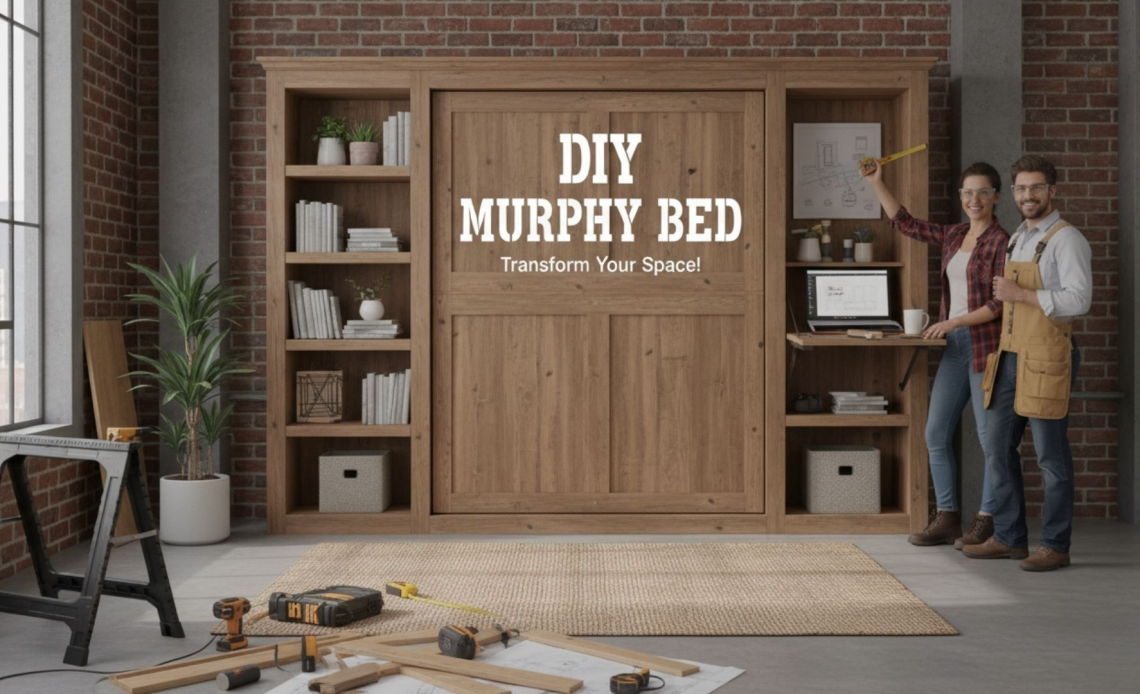
If you have a room doing double duty as an office, playroom, or hobby space, a Murphy bed is one of the smartest upgrades you can make.
The problem is that ready made wall beds often run into the thousands once you add cabinetry and installation.
A well planned DIY Murphy bed solves the same problem for a fraction of the price, while letting you match the style to your home.
This guide walks through the big decisions, realistic costs, and the build sequence so you can decide if this is a project you want to tackle.
Is A DIY Murphy Bed Right For You?
A Murphy bed is not a beginner’s very first project, but you do not need to be a master carpenter either.
Most hardware makers and installers describe it as an intermediate build that demands accurate measuring, square cabinet construction, and comfort with drills and saws.
One detailed comparison of DIY and installed beds estimates about 8 to 12 hours for a straightforward installation, not including paint and trim.
On the cost side, a complete professionally supplied and installed Murphy bed typically falls somewhere around 2,000 to 4,000 dollars, depending on size, finishes, and extras such as shelving or a desk.
DIY flips that equation. A typical project uses:
- A dedicated Murphy bed hardware kit
- Cabinet grade plywood and basic lumber for trim and shelving
Real world builds using a midrange hardware kit plus plywood often land in the 600 to 800 dollar range before the mattress, based on published material lists and cost breakdowns from experienced DIYers.
If you already own tools and are comfortable reading plans, a DIY Murphy bed can be one of the highest impact projects you will ever take on.
Read More: What Is A Murphy Bed?
Plan The Bed Around Your Room
Pick the size
Start with the mattress size you want to use. Most DIY hardware kits are designed around standard mattresses: twin at 39 by 75 inches, full at 54 by 75, queen at 60 by 80, and king at 76 by 80.
Queen is the sweet spot for most guest rooms because it comfortably sleeps two adults without dominating the room.
A vertical queen Murphy bed cabinet is typically a little under 7½ feet tall and a bit over 5 feet wide, with a depth around 18 to 21 inches and a projection into the room around 85 to 87 inches when open.
In plain language, that means you need:
- Ceiling height close to 8 feet
- Clear floor space from the wall to any opposite obstruction of at least 7½ feet
Measure your existing mattress if you plan to reuse it, and confirm that its thickness matches the limits in your chosen hardware instructions.
Many kits and manufacturers recommend mattresses in the 8 to 12 inch range so the bed folds and latches correctly.
Vertical or horizontal?
Vertical Murphy beds hinge at the head of the bed. They stand tall like a closet when closed, then fold down lengthwise.
This works well on walls with full height clearance and looks proportionate in most bedrooms.
Horizontal beds hinge along a side. They stretch wider and shorter, which can be a better fit under a low window, in a room with a low bulkhead, or along a long wall in a home office.
Many hardware kits are available in both orientations, so you can make this decision before you buy.
Study the wall and floor
Every safe Murphy bed has one thing in common: solid anchoring. Whether the kit is wall mounted or floor mounted with wall bracing, the structure has to attach securely to framing or masonry, not just drywall.
Use a stud finder to mark stud locations on the chosen wall and confirm that nothing critical, such as plumbing, will be behind your main fastener points.
In many houses, studs are spaced 16 inches on center, which lines up well with the fastening patterns specified in hardware manuals.
If your floor is very out of level, or you have an older home with questionable framing, factor in extra time for shimming, additional blocking, or a consult with a contractor.
Choose The Right Hardware Kit
The hardware kit is the heart of the project. It determines how smoothly the bed moves, how safe it is to operate, and how easy the build will be.
Most complete DIY Murphy bed kits include the lift mechanism, pivot hardware, legs, mounting brackets, and a detailed cut list and fastener schedule.
You will see two main styles of lift mechanism:
Spring systems use multiple steel springs to counterbalance the bed. They are tunable, since you can often add or remove springs to match your mattress weight. Many long running Murphy bed companies still use springs in their pro grade kits.
Gas piston systems use sealed gas struts similar to what holds up a car hatch. They feel very smooth and quiet in operation and are often marketed as a premium option.
Both systems can be safe when properly installed. The priorities are clear instructions, support from the manufacturer if you get stuck, and a weight rating that comfortably exceeds your planned mattress and frame.
On price, basic DIY hardware kits for twin through queen commonly start in the 180 to 300 dollar range, while more elaborate or heavy duty mechanisms, especially for larger beds or integrated desks, can run several hundred dollars more.
Spend where it counts here. Quality hardware is what makes the bed feel safe every time you pull it down.
Read More: Size Of A Bunk Bed
Materials, Tools, And A Realistic Budget
Most modern DIY Murphy beds use ¾ inch cabinet grade plywood for both the bed frame and the outer cabinet. That thickness gives a solid feel and holds fasteners well.
One popular project, for a queen size unit, called for four sheets of ¾ inch plywood plus two sheets of ¼ inch plywood for the back, along with a hardware kit, for a total materials cost just over 700 dollars at common big box prices.
Another woodworker reported spending about 650 dollars on plywood and hardware for a custom build, not counting the mattress.
These examples line up with what many kit makers describe as typical: several hundred dollars for the kit plus a few hundred for wood and finish.
For tools, you will want at minimum a circular saw with a straightedge guide or a table saw, a drill and impact driver, a router or sander for clean edges, a stud finder, long levels, and lots of clamps.
You can absolutely build with a compact garage setup if you take your time and make careful cuts.
Build In Stages
Breaking the project into clear stages keeps it from feeling overwhelming.
1. Build the bed frame
The inner bed frame is basically a reinforced box sized precisely to your mattress.
Many published plans begin with cutting the plywood rails and crosspieces, assembling the frame with glue and screws, and then adding slats or a plywood deck for mattress support.
Take your time here. A frame that is square and flat will make the pivoting and latching feel smooth later.
2. Build the wall cabinet
The outer cabinet functions like a shallow wardrobe. You build two tall side panels, a top, and often a fixed bottom rail that can sit slightly off the floor.
Once assembled, this cabinet is anchored to the wall or floor according to your kit instructions.
Check for square repeatedly. A cabinet that twists or racks will fight you when you attach the moving bed frame.
3. Install the hardware
Next you install the pivot hardware and lift system. This means fastening metal brackets to the lower corners of the bed frame and matching plates to the cabinet sides, then attaching springs or pistons.
A good kit will give you precise dimensions for these locations.
Follow the sequence step by step. Do not guess at fastener sizes or substitute hardware that is not rated for the loads involved.
4. Anchor and test
With the hardware attached, you can swing the bed into place and test the action while the cabinet is temporarily braced. This is when you fine tune spring tension or piston mounting if the instructions allow it.
Once you are satisfied, fully anchor the cabinet to at least two studs, ideally three or more, using the structural screws specified by the hardware maker.
Safety guides from installers and manufacturers all stress this step: wall beds must not rely on drywall alone.
Open and close the bed repeatedly, listening for any scraping or binding, and verify that the legs land evenly on the floor.
5. Finish and style
After the mechanics are dialed in, you can focus on how the bed looks in the room.
Many DIYers add face panels that mimic shaker doors, build bookshelves at the sides, or integrate a desk on the back of the bed so that when it is folded up, the room looks like a built in cabinet wall instead of a bed.
Whether you paint, stain, or mix both, choose finishes that match existing trim so the piece feels like it came with the house.
Read More: Saving Space with 10 Multifunctional Furniture Ideas for Stylish Small Living
Safety Rules You Cannot Skip
Murphy beds have been in use for over a century, and modern hardware is very reliable when installed correctly. Safety issues almost always trace back to shortcuts.
Anchor into structure. Every source, from kit makers to independent safety guides, agrees on this point. Fasteners must bite into studs or solid blocking, not just drywall.
Respect weight and thickness limits. Do not overload the bed with a very heavy mattress or extra bedding if your kit is not rated for it.
Follow the specified mattress thickness so the locking mechanism works as designed.
Inspect regularly. Make it a habit to check mounting screws and hardware every few months, especially in the first year, and tighten anything that has worked loose.
Teach kids in the house that the bed is not a toy. No hanging from the underside, no jumping on as it is coming down. It sounds obvious, but clear rules prevent rough use that hardware was never designed to handle.
Conclusion
A DIY Murphy bed is a commitment of time, money, and focus, but the payoff is huge.
You gain a comfortable guest bed that disappears when you do not need it, a room that finally works the way you want, and a project you can be proud of every time you fold it down.
With realistic planning, a good hardware kit, and respect for the safety details, you can absolutely build one yourself.
