
Walk into almost any traditional bedroom in the United States and you are likely to find a box spring under the mattress, even if no one in the house can explain exactly what it does.
For years it was treated as a non negotiable part of a bed. Then memory foam, hybrids, and sleek platform frames arrived and suddenly people started asking a fair question do you still need a box spring at all?
To answer that, it helps to start with the basics of what a box spring is, how it is built, and what role it plays in a modern sleep setup.
Box Spring Basics
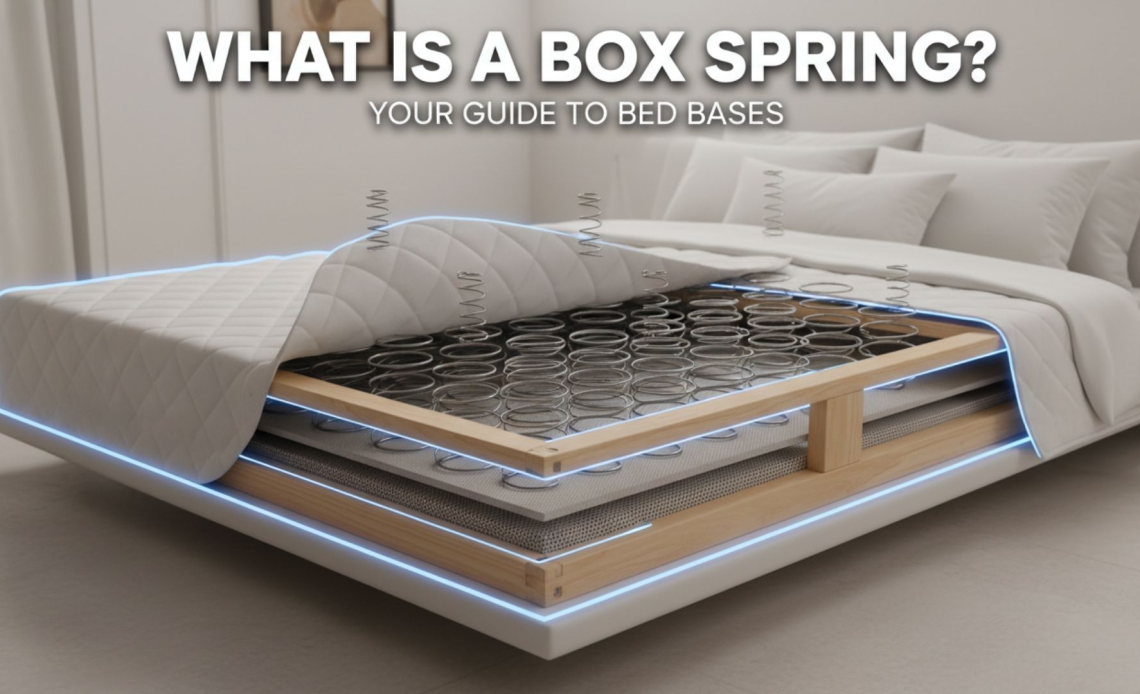
A box spring is a mattress sized bed base made from a sturdy wooden or metal frame, filled with metal springs or a spring grid, and wrapped in fabric.
It sits on top of a bed frame or directly on the floor, with the mattress resting on top. Together, the frame, box spring, and mattress create the full bed.
The box spring was about the same footprint as the mattress and came in all the familiar sizes: twin, full, queen, king, and California king. Standard models are fairly tall, which is why older beds often sit quite high off the floor.
To fit different decorating styles and accessibility needs, manufacturers now offer several heights instead of a single one.
Traditional construction
Inside a classic box spring you will usually find:
- A rectangular wooden or metal frame that defines the shape
- A network of metal coils or a spring grid attached to that frame
- A thin layer of padding over the springs
- A fabric cover that encloses everything for a finished look
Those internal coils are what set a true box spring apart from other bases. The springs compress and rebound slightly under the weight of the mattress and sleeper, so the base acts as a shock absorber instead of just a rigid platform.
Many products sold today under the box spring label, especially budget models, are actually non spring foundations that only look like traditional box springs from the outside.
The difference matters when you start pairing a base with modern foam or hybrid mattresses.
Read More: How To Cover A Box Spring?
What Does a Box Spring Actually Do?
Box springs became popular at a time when mattresses were thinner and less structurally stable. They provided several useful functions at once.
They add height. Lifting the mattress farther from the floor makes it easier to get in and out of bed and can help the bed feel more substantial in a room.
In earlier centuries that extra height also improved hygiene by putting more distance between sleepers and a cold or dirty floor.
They provide shock absorption. The spring system inside the box flexes under pressure, so your body weight is not concentrated only in the mattress coils.
This can make a traditional innerspring mattress feel softer and can reduce wear on the mattress over time.
They help distribute weight more evenly across the frame underneath. Instead of a few slats taking all the load, the box spring spreads pressure across its entire surface.
That can protect older metal frames and reduce the risk of sagging.
A box spring can improve airflow under the mattress, especially compared with placing a mattress directly on solid wood or the floor.
That extra ventilation helps moisture dissipate and can keep the sleep surface feeling fresher.
Types of Box Springs You Will See in Stores
When you shop for a box spring in the United States today, you are really choosing among a few related styles rather than one standard product.
Standard and low profile box springs
A standard box spring, sometimes called high profile, is usually around 8 to 9 inches tall.
This is the classic height that creates a tall, traditional looking bed. For people who prefer a lower bed or already have a thick mattress, manufacturers also offer low profile versions around 5 to 6 inches tall.
The internal support can be similar, but the shorter design keeps overall bed height down.
Split box springs
Queen, king, and California king mattresses are large and often difficult to maneuver through stairwells and doorways.
A split box spring solves this by dividing the base into two narrower pieces that fit side by side under one mattress.
Each half is lighter and easier to move, and together they provide the same footprint and support as a single piece base.
Split designs are common in multi story homes and older houses with tight turns in the hallway. They are also useful if you anticipate moving frequently and do not want to wrestle a bulky foundation every time.
Read More: Low Profile Vs Standard Profile Box Spring
Ultra low profile bases and bunkie boards
At the thinnest end of the spectrum are ultra low profile bases, often only about 2 inches thick. Many of these no longer contain coils and are closer to reinforced panels or so called bunkie boards.
They are used when you want the mattress as low as possible or when you need to add just a thin layer of support over slats.
Box Spring vs Foundation vs Platform Bed
Because many products now share a similar exterior look, the terms box spring, foundation, and platform bed are often mixed together. In practice, they are not the same thing.
A true box spring, as described earlier, includes springs inside a fabric covered frame. Its key role is to add bounce and act as a shock absorber for an innerspring mattress.
A foundation is a rigid mattress base. It usually consists of a wooden or steel frame with evenly spaced slats or a solid top, wrapped in fabric.
It may look like a box spring but does not contain coils. Its job is to hold the mattress flat and prevent sagging rather than provide extra bounce.
A platform bed is a complete bed frame with a built in support surface for the mattress, typically wood or metal slats.
With this style, the platform itself replaces both box spring and separate foundation. Many platform frames are designed so that you can place a mattress directly on the slats and skip any additional base.
Understanding these distinctions is important, because mattress warranties are written around the type of support underneath.
Some manufacturers accept a rigid foundation or platform but specifically exclude springy box springs for certain mattress types.
Do You Still Need a Box Spring Today?
Modern mattress technology has changed the role of the box spring. For many buyers it is now optional or even discouraged.
Innerspring mattresses with interconnected coils still pair well with box springs.
The spring on spring setup spreads impact, can make the bed feel more responsive, and may extend the comfort life of the mattress.
If you are using a basic metal bed frame with only a perimeter and a few cross bars, a box spring can also provide the solid surface that frame lacks.
On the other hand, many memory foam, latex, and hybrid mattresses are designed to sit on firm, non yielding surfaces.
Sleep brands and independent reviewers consistently note that these mattresses usually do not require box springs and may even perform worse on them.
Instead, they call for a platform frame, slatted base with close spacing, or a rigid foundation.
Some manufacturers warn that placing a foam or hybrid mattress on an old fashioned box spring can void the warranty, because the extra give under the mattress can lead to improper support or premature sagging.
That is why the advice from many sleep experts is to choose the mattress you like first, then read the fine print on what type of base it needs.
Cost is another factor. A quality box spring for a larger bed can cost roughly one to a few hundred dollars, and you still need a separate bed frame.
A platform bed, while more expensive up front, often replaces both those pieces and offers built in style and storage.
Box springs are no longer universal requirements. They are most useful if you have a traditional innerspring mattress, a minimal metal frame, and you like a higher, bouncier feel.
Read More: Platform Bed Vs Box Spring: Which is better?
How to Choose and Use a Box Spring?
If you decide that a box spring fits your bed and your preferences, a few practical checks will help you get it right.
Start by matching the size. Pair each mattress with a box spring of the same size, so a queen mattress sits on a queen box spring and so on. Mismatching sizes can create unsupported edges and uneven wear.
Measure total bed height. Add up the thickness of the mattress, the box spring, and the frame. Make sure the final height is comfortable for you and any partners who will use the bed.
People with limited mobility often prefer a bed height where knees are close to a right angle when sitting on the edge.
Look at the support underneath. For queen size beds and larger, choose a frame with a strong center rail and legs reaching the floor.
This avoids concentrating all the weight on the edges of the box spring and helps prevent bowing in the middle over time.
Think about access and moving. In multi story homes or apartments with narrow hallways, a split box spring can save a lot of frustration.
You get full support in the bedroom without trying to bend a rigid frame around tight turns.
Protect your investment. A simple box spring cover helps keep dust and allergens out of the fabric and gives the base a clean, finished look, especially with metal frames where the sides are visible.
It can also reduce scuffs and wear from vacuum cleaners and pets.
Conclusion
A box spring is more than just the thing under the mattress that no one thinks about.
At its core, it is a fabric covered frame full of springs, designed to add height, cushion impact, and support older style innerspring mattresses.
In the era of foam and hybrid beds, that role has shifted. Many sleepers now get better results from solid foundations or platform frames, while box springs remain useful for specific mattress types and setups.
The smartest way to decide is to start with the mattress, read what kind of base it needs, and then choose the support system, whether that is a box spring, a foundation, or a platform bed.
When you understand what a box spring actually does, you can skip outdated habits, keep your warranty intact, and build a bed that feels right every night.
