
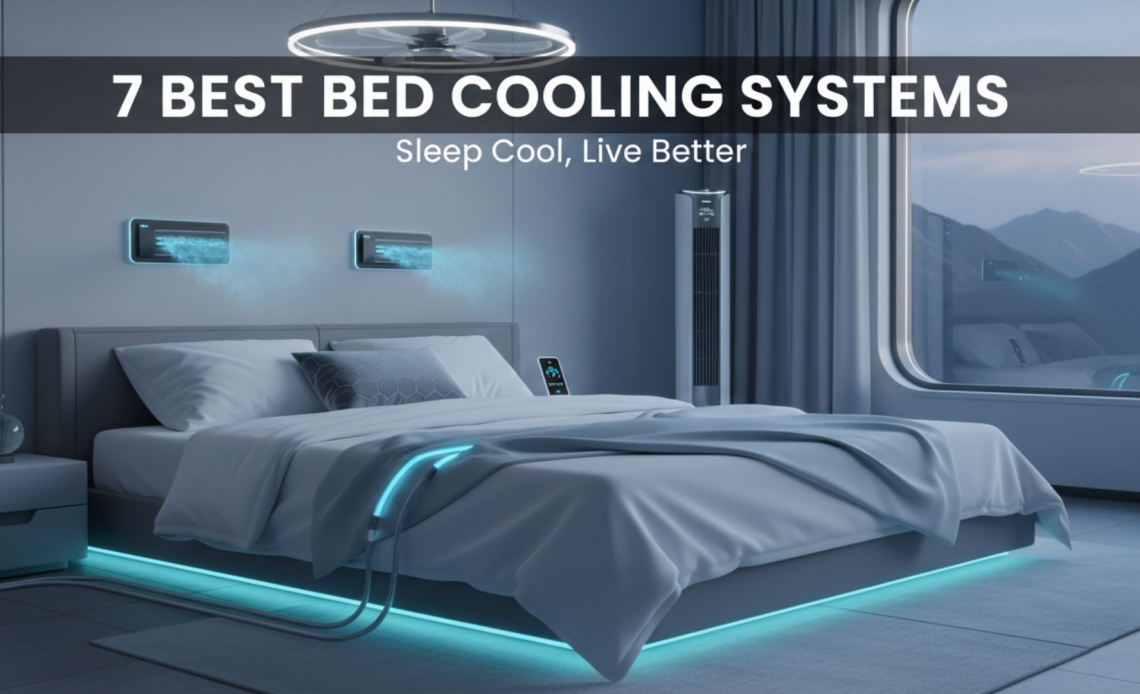
Waking up sweaty, kicking off the covers, pulling them back on, then staring at the ceiling at 3 a.m. is a special kind of torture. For many people, the problem is not the mattress at all. It is bed temperature.
Sleep researchers generally place the ideal bedroom temperature for most adults somewhere in the low to mid 60s Fahrenheit.
If your room or mattress runs warmer than that, your body struggles to drop its core temperature, which makes it harder to fall asleep and stay asleep. That is where active bed cooling systems come in.
Unlike cooling mattresses or breathable sheets, these devices actually move air or water to pull heat away from your body and keep your sleep surface in a comfortable range all night.
Below are seven of the most capable systems available today, with options for every budget, from premium smart covers to compact, water based pads.
How do bed cooling systems work?
Most bed cooling systems fall into three broad families.
Water cooled pads:
Brands like Sleepme circulate temperature controlled water through thin channels in a mattress pad.
Water transfers heat more efficiently than air, which is why these systems can often cool a bed surface into the mid 50s Fahrenheit and also provide gentle warmth in winter.
Air based systems:
Companies such as BedJet blow temperature controlled air under your top sheet or through a special top sheet.
The airflow whisks away heat and moisture and can feel more like having a very targeted fan or heater.
Evaporative and hybrid coolers:
Newer devices combine a thin pad with a small water tank and fan. The fan moves air through or across a damp medium, which cools as water evaporates.
These systems can be more energy efficient, though they usually do not cool as aggressively as full hydronic setups.
What to look for in a bed cooling system?
Before we get into specific products, it helps to know which specs matter most in real life.
- Temperature range and cooling power: If you are a truly hot sleeper or dealing with night sweats, look for systems that can bring surface temperature down into the high 50s or low 60s Fahrenheit and hold it there, not just feel a little cooler than room temperature. Water based systems tend to win here.
- Single zone versus dual zone: Couples almost never agree on the perfect sleep temperature. Dual zone systems let each side of the bed run at its own setting, which can be worth the price premium if one of you sleeps hot and the other cold.
- Noise, footprint and maintenance: Any unit with a pump or fan will make some noise and will need occasional cleaning. Water based systems require topping up and periodic flushing to avoid mildew, similar to a humidifier. Air based systems are simpler to maintain but can rustle sheets or create a light fan sound.
- Data and automation: Some premium systems now bundle sleep tracking, smart alarms and automatic temperature adjustment based on your sleep stage. If you like data or already use a smartwatch to track your nights, that extra layer can be valuable.
With that in mind, here are seven standout bed cooling systems to consider.
Read More: When Is The Best Time To Buy A Mattress?
1. Eight Sleep Pod: Best overall smart cooling system
For people who want the most advanced temperature control paired with serious sleep tracking, the Pod line from Eight Sleep is the benchmark.
Instead of replacing your mattress, the Pod Cover zips over it like a thick fitted sheet. Inside are water channels and sensors connected to a bedside Hub.
The Hub continuously circulates cooled or warmed water through the cover and adjusts temperature based on data from your body and the room.
Recent models like the Pod 4 and Pod 5 can cool each side of the bed as low as around 55 degrees and warm up into the low 100s, with independent settings for both sleepers.
Everything is controlled from a polished app. You can schedule the bed to pre cool before you lie down, ramp slightly warmer toward morning or wake you with a gentle vibration instead of a blaring alarm.
The system also tracks heart rate, heart rate variability, respiratory rate and sleep stages without a wearable and surfaces trends over time.
The drawbacks are cost and complexity. You pay a premium for both the hardware and, on newer models, a subscription if you want the most advanced features.
For tech focused users and athletes who care about recovery, though, the Pod is hard to beat.
2. Sleepme Chilipad Dock Pro: Best for serious hot sleepers
If you run hot enough that regular cooling mattress toppers barely make a difference, the Chilipad Dock Pro is designed with you in mind.
The system pairs an ultra thin, tubeless mattress topper with a compact control unit that sits beside or under the bed.
Chilled or heated water circulates between the Dock and the topper, giving you a programmable temperature range from about 55 to 115 degrees Fahrenheit.
Reviewers consistently note that the Dock Pro cools faster and more aggressively than older models, while running more quietly.
You can control the Dock Pro from the Sleepme app or use on device buttons if you prefer to avoid Wi Fi.
The app lets you schedule temperature curves across the night, for example starting slightly warmer at bedtime and dipping cooler during deep sleep.
The topper itself is machine washable, which makes maintenance easier.
On the downside, there is some setup and regular cleaning involved. You will need to monitor the water level, run cleaner through the system and occasionally drain the lines.
If you are willing to put in that bit of work, Dock Pro is one of the most powerful bed coolers you can buy without replacing your mattress.
3. BedJet 3 Climate Comfort System: Best air based solution
The BedJet 3 takes a different approach. Instead of cooling your mattress surface, it blows temperature controlled air directly into your bedding.
A low profile base unit sits under or beside the bed, connected to a flexible hose that tucks under your top sheet or into a special Cloud Sheet.
The system can blast cool air to strip away built up heat and moisture or send warm air for a cozy, dryer like feel.
Because it is moving air rather than water, the response is almost instant. Many users rely on it specifically for night sweats and hot flashes.
Noise levels are comparable to a small fan, roughly in the 30 to 46 decibel range according to the company, which most sleepers perceive as a soft white noise.
BedJet 3 works on virtually any mattress and bed frame, including adjustable bases, and there are dual zone kits so each side of the bed can control its own temperature.
If you hate the idea of lying on tubes or worrying about leaks, an air based system like this is a strong alternative.
Just know that if your room itself is very warm and humid, air cooling will not feel quite as dramatic as the coldest water based systems.
Read More: Best Material For Duvet Cover
4. Sleep Number DualTemp Layer: Best plug and play topper
If you already sleep on a smart bed from Sleep Number or want something that feels close to a traditional pad, the DualTemp Individual Layer is worth a look.
DualTemp is a padded layer that lies on top of your mattress. Inside are channels that connect to a compact heating and cooling unit.
You control everything from a simple handheld remote, choosing among multiple levels of warming or cooling.
The pad comes in half sizes that cover one side of a queen, king or California king, which is ideal if only one partner runs hot.
Compared with more advanced systems, DualTemp is fairly straightforward. There is no app, no sleep tracking and no complex scheduling, which some people actually prefer.
It is a practical choice if you want a familiar feeling topper that can gently cool you down before bed and keep you from overheating without much tinkering.
5. Chilipad Cube Sleep System: Best mid priced hydronic cooler
While Dock Pro is the current flagship, the Cube Sleep System remains a popular way to get into water cooled mattress pads at a slightly lower price point.
The Cube system uses a mesh mattress topper with embedded tubing connected to a cube shaped control unit that pumps water through the pad.
It offers a temperature range of about 60 to 115 degrees, with single or dual zone options so couples can set their own preferences. You can adjust settings on the unit or via a basic remote.
It lacks some of the app based scheduling and extra cooling power of Dock Pro, but the fundamentals are similar.
All night temperature regulation across your sleep surface. For many hot sleepers, that is the piece that makes the biggest difference.
6. AquaPad Breeze: Best compact, energy efficient pad
AquaPad Breeze is a slim water cooling mattress pad that targets people who want a cooler bed without a big, noisy unit or high power draw.
The system pairs a microfiber pad with a small control module and handheld remote. It relies on a combination of water circulation and evaporative cooling to pull heat away from your body.
Marketing materials quote an energy use of around 0.1 kilowatt hours per night, which is dramatically lower than running central air colder for the whole home.
Because it emphasises efficiency and portability, AquaPad will not frost your bed the way a heavy duty hydronic system can.
For moderate hot sleepers in smaller spaces, though, it offers a nice balance between comfort, simplicity and running cost.
7. Adamson B10 Bed Cooling System: Best budget water cooler
The Adamson B10 is often recommended as a more affordable entry into active bed cooling.
At its core, it is a cotton mattress pad connected to a compact unit that circulates water through the pad and uses a fan for evaporative cooling.
You get four fan modes and remote control, and the whole system is relatively lightweight compared with many competitors.
The focus here is on delivering noticeable surface temperature relief and dryer sleep to people dealing with night sweats or hot flashes.
There are trade offs. The B10 is typically sold in twin size, so it suits solo sleepers or one side of the bed.
Because it relies partly on evaporation, it can add some humidity to the room, which not everyone will love in already muggy climates.
Still, for the price, it is a compelling way to test whether an active cooler really solves your problem before investing in a premium system.
Which bed cooling system is right for you?
A premium hydronic system like the Pod or Dock Pro makes the most sense if you are constantly too hot, willing to maintain a water based device and interested in sleep data or automation.
These are serious investments, but they offer the most precise and powerful temperature control.
If you want something less expensive and easier to live with, a mid range pad such as Chilipad Cube or a straightforward topper like DualTemp can narrow the gap between too hot and just right without completely overhauling your setup.
For many, an air based system like BedJet is the most user friendly option. There is no water to manage, installation is simple and the feel of moving air is very intuitive if you already sleep with a fan.
Finally, compact systems such as AquaPad Breeze or Adamson B10 are good experiments.
They work best in small or single person setups and are particularly appealing if you care about energy use or do not have the space for a larger control unit.
Read More: Mattress Size For Platform Bed
Conclusion
Even the best bed cooling system works best alongside a few low tech habits.
Aim to keep your bedroom itself reasonably cool, ideally somewhere in the 60 to 67 degree range, and use breathable sheets and a lighter comforter in warm months.
Try to avoid heavy exercise, large meals and alcohol close to bedtime, since all three can raise your core body temperature.
A short, lukewarm shower before bed and a consistent sleep schedule also help your body recognise when it is time to wind down.
Get those basics in place, then let a well chosen cooling system do the fine tuning. When your bed feels like a calm, cool refuge instead of a sauna, everything about sleep gets easier.
