
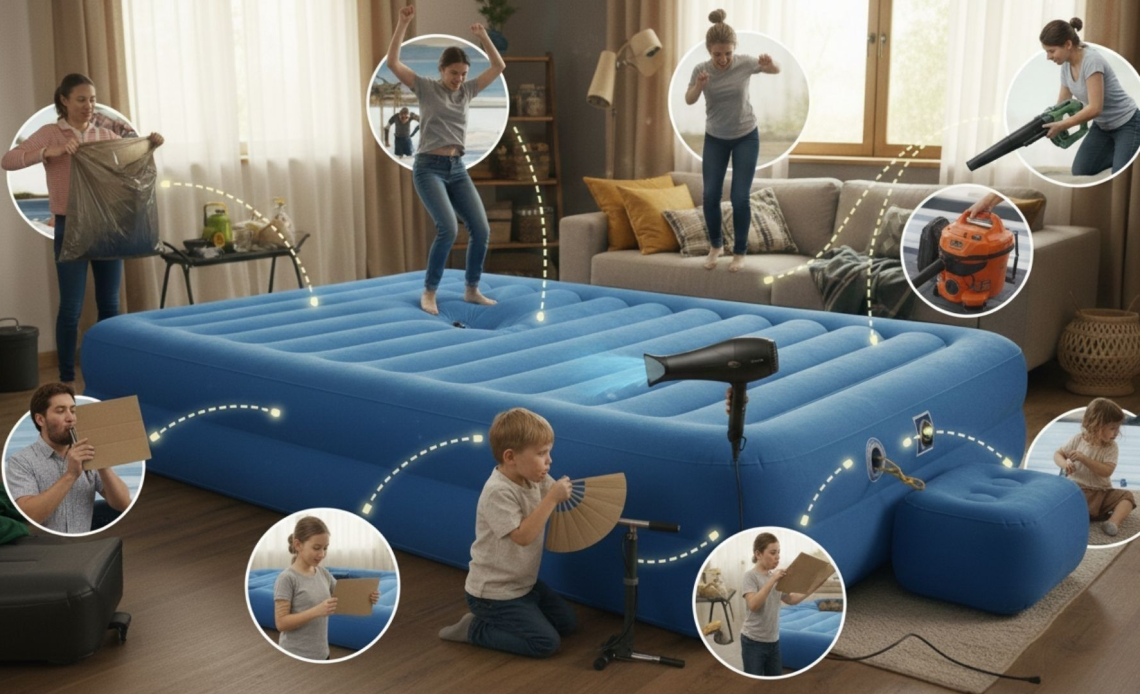
Waking up on a half flat air mattress is bad. Realizing you never packed the pump is worse. The good news is that you can still get a firm, comfy bed using things you already have at home or at the campsite.
From hair dryers to trash bags, there are several safe and surprisingly efficient ways to inflate an air mattress without a dedicated pump.
The key is to move a lot of air through the valve while protecting the mattress from heat, sharp edges, and overinflation.
Before You Start: A Few Quick Checks
Before you try any method, take a minute to set yourself up for success.
Inspect the mattress for obvious leaks. If there is a hole or split seam, no clever trick will keep it firm for long. Check the valve as well and make sure it closes snugly.
Clear the area. Inflate the mattress on a smooth, clean surface so it will not rub against gravel, splinters, or sharp debris.
Understand your valve style.
- One way valves let air in but not out. They are ideal for makeshift inflation methods.
- Two way valves open both ways, so you may need to pinch or hold the flap open while you blow air in.
Once that is done, you are ready to try one of these seven no pump methods.
Read More: How To Inflate an Air Bed?
1. Use a Hair Dryer (On Cool Air Only)
A basic hair dryer can double as a small blower and is one of the easiest ways to inflate an air mattress at home.
Set the dryer to its coolest temperature. Hot air can soften or warp vinyl and plastic, and in extreme cases may even damage the valve. Keeping the heat off greatly reduces the risk of deforming the mattress material.
Hold or tape the nozzle of the dryer against the mattress valve. You want as tight a seal as possible so air does not escape around the edges.
If the valve is small, you can wrap a bit of cloth or a rubber band around the connection to help close any gaps.
Switch the dryer on and let it run. It will usually take longer than a proper pump because the airflow is more dispersed, but you can improve efficiency by:
- Keeping the mattress mostly flat while it fills, so air spreads evenly.
- Gently smoothing and lifting the mattress as it starts to rise, which helps remove trapped folds.
Stop when the mattress feels firm but still has a bit of give under your hand. Overfilling puts stress on seams and shortens the life of the mattress.
Best for: Indoors or anywhere you have electricity and a hair dryer, but no pump.
2. Turn a Vacuum Cleaner into a Blower
Many household vacuums can be used in reverse to push air instead of sucking it in. This moves a lot of air quickly and can inflate a mattress in just a few minutes.
If your vacuum has a built in blower port, move the hose from the intake port to the exhaust port.
If not, some older upright bagged models allow you to detach the bag and connect the hose to the outlet where the bag attaches, which turns the machine into a blower.
Position the hose end or nozzle over the mattress valve. Again, aim for the tightest seal you can manage, even if that means wrapping tape or a cloth around the joint.
Turn on the vacuum and let the air stream into the mattress. Stay nearby and feel the mattress as it fills.
This method is powerful, so you want to stop as soon as the mattress is comfortably firm.
A couple of cautions:
- Do not block the exhaust almost completely for long periods, or you can overheat the vacuum motor.
- Avoid using this method with extremely cheap or very old air mattresses where seams are already stressed.
Best for: At home, in a garage, or near a power source, when you have a household vacuum or shop vac.
3. The Trash Bag Air Scoop Method
This is the classic no electricity fix and works well when camping or in a power outage. A large, sturdy trash bag becomes a kind of manual air pump.
Choose a heavy duty garbage bag, not a thin kitchen liner. Thicker plastic is less likely to tear while you work.
Open the bag wide and scoop air into it with a quick upward motion, almost like you are catching wind with a sail.
Once the bag is full and puffy, quickly twist or pinch the open end closed so you trap the air inside.
Now place the twisted opening over the mattress valve. Try to tuck the valve into the bag opening so it is surrounded by plastic. Hold tightly to keep the connection as airtight as you can.
Lean on or press down on the trash bag to push the trapped air into the mattress. When the bag is flat, repeat the scooping process.
It is repetitive, but it works, and you can get a surprisingly firm mattress after several cycles.
If your mattress uses a two way valve, you may need a second person to hold the valve flap open while you press on the bag. One way valves are easier because air flows in and does not rush back out.
Best for: Camping or situations with no electricity and no tools, as long as you have a big bag and some patience.
4. Inflate with a Leaf Blower or Powerful Fan
If you have access to a leaf blower, it can fill an air mattress very quickly. Even a strong portable blower or shop fan can help if you can narrow the airflow at the outlet.
Place the blower’s outlet against or just over the valve. Because leaf blowers often have a wide opening, it helps to:
- Use your hand to cup the outlet around the valve.
- Wrap a cloth or old T shirt around the joint to cut down on escaping air.
Turn the blower on at a low setting first. The airflow is intense, and running at full blast from the start can distort the mattress as it begins to fill. Once it has some shape, you can increase the power and finish inflating.
Stay close and monitor firmness. Leaf blowers move so much air that overinflation is a real risk if you walk away for even a minute.
Best for: Garages, yards, or campsites near a vehicle or generator when you already have a leaf blower handy.
Read More: What Are Comfortable Air Mattress Alternatives?
5. Use a Compressed Air Canister
Compressed air canisters, often sold for cleaning keyboards or electronics, can be used in a pinch to get air into a mattress valve.
Attach a narrow nozzle or straw that fits the valve opening. Hold the nozzle inside or flush against the valve, then press the trigger to release air into the mattress.
This method is fast per burst, but most canisters are small. You will likely need several cans to fill a full size mattress, which can get expensive.
It also works better as a top up method to firm up a sagging mattress rather than inflating from completely flat.
Important safety notes:
- Keep the can upright while spraying so liquid propellant does not blow directly into the mattress.
- Allow the can to warm up between bursts. Prolonged spraying chills the metal and can make the can uncomfortably cold to hold.
Best for: Quick top ups or emergency inflation when you have compressed air on hand and no other tools.
6. Turn Bottles or Bags into DIY Hand Pumps
If you have a sturdy plastic bottle and a short piece of flexible tubing, you can build a simple hand pump.
Push one end of the tube snugly into the bottle neck and the other end into the mattress valve. If the tubing or valve is loose, wrap tape or cloth around the connection to tighten it.
Squeeze the bottle repeatedly so it pushes air along the tube and into the mattress. Refill the bottle with air between squeezes by letting it expand again.
The airflow per squeeze is not huge, so this method is slower than a trash bag, but it is very controlled and gentle on the mattress seams.
A variation on this is using small plastic bags in your hands instead of one large garbage bag.
Fill each bag with air, press it into the valve opening one at a time, and squeeze. It is more labor intensive but works if you only have smaller bags available.
Best for: Camping or road trips when you have bottles or tubing, but not a pump.
7. Old School: Inflate by Mouth or With a Straw
If all else fails, you can still inflate an air mattress with your lungs. It is the most tiring option, but it is reliable and needs no tools at all.
Clean the area around the valve. A quick wipe with a clean cloth or sanitized wipe makes the process more hygienic.
Place your mouth over the valve opening and exhale steadily. It helps to take deep breaths and blow in a slow, continuous stream rather than quick bursts.
If the mattress has a two way valve, you may need to pinch it open with your lips or fingers while you blow.
Take breaks as often as you need. Inflating a large mattress this way can make you lightheaded if you push too hard without resting. If there are two of you, alternate turns so no one gets too tired.
If you prefer not to put your mouth directly on the valve, insert a clean straw or narrow tube instead. This keeps your lips away from the plastic and can feel more sanitary, especially if several people are helping.
Best for: Absolute last resort situations with no tools, no power, and no bags or bottles, especially for smaller mattresses.
When These Tricks Are Not a Good Idea?
There are a few scenarios where it is better to avoid improvising:
If the mattress has a clear leak, focus on patching first and only then worry about inflation.
If someone has respiratory issues, skip mouth inflation and use methods that rely on devices or bags instead.
If the mattress is very old or already showing stress at seams, be gentle with high powered devices like vacuums and leaf blowers. Choose slower, lower pressure options such as the trash bag or bottle methods.
It is worth investing in a compact manual or battery powered pump once you are back home. The tricks above are excellent backups, but a real pump saves time and effort and is easier on your gear.
Read More: Queen Air Mattress Dimensions And Guide
Conclusion
Inflating an air mattress without a pump is inconvenient, not impossible. With a little creativity, everyday items like hair dryers, vacuums, trash bags, bottles, and even a simple straw can give you a firm, comfortable place to sleep.
The key is to move air efficiently, protect the mattress from heat and overpressure, and stop as soon as it feels comfortably firm.
Learn one or two of these methods now, and the next time a pump goes missing, you will still be asleep on a proper bed instead of a sad, flat cushion.
