
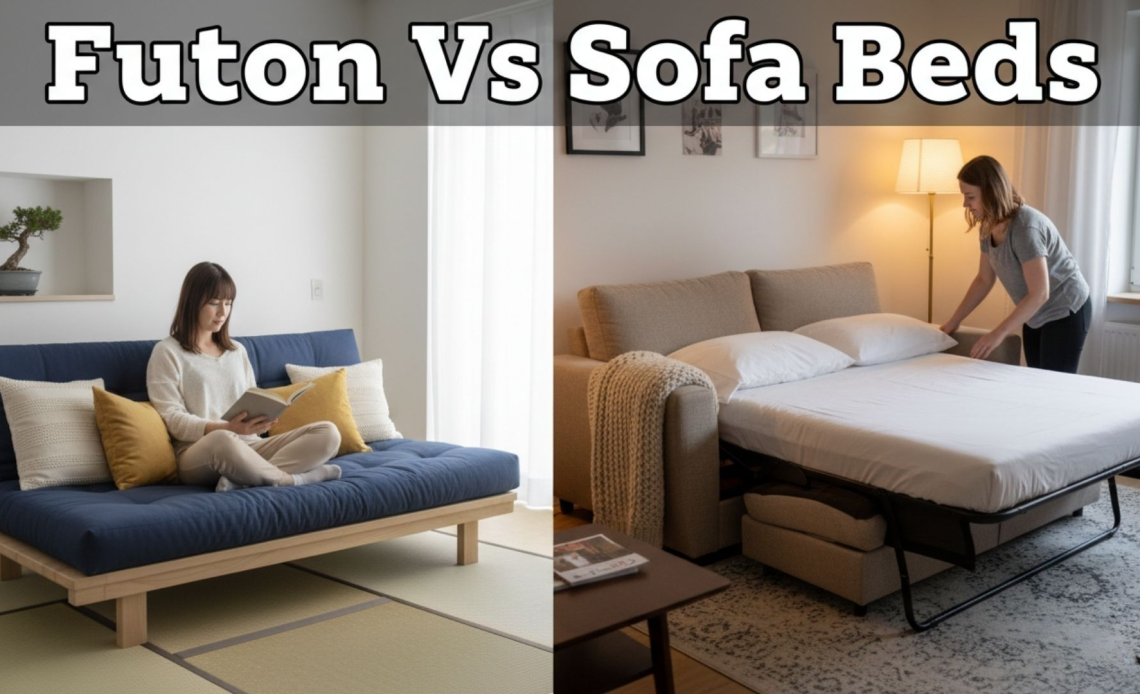
If you are trying to squeeze more function out of every square foot, a convertible piece of furniture is an obvious choice.
The real question is which way to go: a futon or a sofa bed. On paper they do the same job. In daily life they feel very different.
This guide walks through how each one is built, how they sleep, how they age, and who each is best for, so you can choose confidently instead of guessing.
What Is A Futon?
At its core, a modern futon is a simple idea. You have one mattress cushion that does double duty as both seat and bed, laid over a folding frame.
During the day the frame is set upright and that cushion acts as a sofa seat and back. At night you release the mechanism, the frame lies flat, and the same cushion becomes your mattress.
Because the cushion has to bend with the frame, it is usually slimmer and more flexible than a standard bed mattress.
Many futon mattresses are cotton, foam, or a blend, and they follow common bed sizes such as twin, full and queen.
Full size futon mattresses, often around 54 x 75 inches, are among the most common choices for small living rooms and studios.
Frames range from basic metal to warmer looking wood slats. Most designs sit closer to the floor than a typical sofa, which helps them feel casual and compact.
That lower profile is a big reason renters, students and first time homeowners gravitate to futons in tight spaces.
Read More: Best 8 Sofa Bed Mattresses
What Is A Sofa Bed?
A sofa bed starts as a regular upholstered sofa. Hidden inside the base is a separate fold out frame with its own mattress.
When you want to sleep, you remove the seat cushions, pull a metal frame forward and unfold it into a flat bed surface.
Because the mattress is separate from the seat, manufacturers can make it thicker and more supportive.
Many current models offer innerspring, pocket coil or memory foam mattresses that feel closer to a real bed than a folded futon cushion.
From the outside, a sofa bed looks like a standard sofa, often with higher arms, deeper seats and a more formal silhouette.
That makes it easy to blend into a living room where you do not want your main seating to scream spare bed.
Futon vs Sofa Bed: Key Differences That Matter
You will see the contrast most clearly in five areas: comfort, space, style, budget and durability.
1. Comfort For Sitting And Sleeping
Futon comfort depends heavily on the mattress quality. A well made futon with a thicker, denser cushion can feel quite good for a night or two, but the fact remains that you sit and sleep on the same piece.
Over time, the areas you sit on most can compress, and because the mattress must fold, it rarely matches the plush feel of a full depth bed mattress.
Sofa beds usually win for sleep comfort. The dedicated mattress is thicker, more protected, and often built with similar technology to stand alone beds.
Many retailer guides point out that high quality sofa beds can offer enough support for regular use, especially when you choose a better grade mattress during purchase.
For sitting, a futon feels firmer and flatter, a bit like a deep bench with a cushion.
That can be comfortable for short stints, reading or gaming, but some people miss the sculpted feel and back support of a traditional sofa.
Sofa beds feel like normal sofas when closed, with shaped cushions and arms that encourage lounging.
2. Space And Layout
Both futons and sofa beds are space saving, but they use space in different ways.
Futons tend to have slimmer frames and a lighter visual footprint. Because the cushion becomes the bed surface, there is no bulky mechanism or hidden frame to house.
They also sit closer to the floor, so they can tuck under windows or in low ceiling lofts without dominating the room. Guides that compare the two often note that futon frames can fold into a tighter profile when not in use.
Sofa beds take more space front to back when you open them. You have to allow clearance to pull the bed all the way out, which can mean moving a coffee table or chair every time you set up for sleep.
When closed they are more compact than a permanent bed, and some layouts only work if your guest bed can disappear into a sofa shape during the day.
3. Style And Aesthetic
Futons read casual and modern. Clean lines, visible wood or metal frames and a straightforward cushion give them an unfussy look.
Swap the cover and the whole feel of the piece changes, so it is easy to refresh on a budget. The trade off is that in more traditional or formal interiors, a futon can look a bit out of place.
Sofa beds blend in with the rest of your soft seating. They are available in the same silhouettes and fabrics as standard sofas, including sectionals, chaise styles and compact two seaters.
If you host often and want guests to feel like they are sleeping in a real room rather than a makeshift one, a sofa bed usually matches that goal better.
Read More: 10 Best Sleeper Sofas & Sofa Beds
4. Budget And Value
On average, futons are friendlier to tight budgets. Many buying guides quote rough price ranges where futons sit in the lower band and sofa beds in the higher one.
Typical futon setups often fall around the equivalent of 300 to 1,000 in many markets, while sofa beds more commonly start higher, around 800 and can easily reach 2,500 or more depending on size and brand.
Part of that gap is the mechanism and mattress inside a sofa bed, which adds complexity and cost.
If you simply need an occasional guest spot for short stays, a good futon can deliver the function you need for less money.
If you want something that behaves like a daily use sofa and a decent bed, the extra investment in a sofa bed can be worth it over time.
5. Durability And Maintenance
A futon has fewer moving parts, which is a plus. The frame folds, but there is no hidden metal bed frame to jam or squeak.
The weak spot is usually the mattress cushion that takes all the load for both sitting and sleeping.
Many retailers suggest that futon mattresses may be comfortable for roughly 5 to 10 years, depending on use, before they start to sag and need replacing.
Sofa beds have more complex hardware, so hinges, springs and joints need occasional checks and gentle handling.
The mattress is protected inside the frame when not in use, which can slow wear.
High quality sofa beds are often rated to last around a decade or longer with normal use, especially if the mechanism is sturdy and the mattress is not overly thin.
Cleaning is easier on futons if you choose a removable cover you can take off and wash. Sofa beds often have fixed upholstery, so you rely more on spot cleaning and professional services.
Which Is Better For Everyday Sleeping?
If someone will sleep on this piece most nights, comfort and long term support matter more than anything else.
A futon can work for everyday sleeping if you:
- choose a thicker, higher quality mattress
- place it on a sturdy slatted frame
- are comfortable with a firmer feel
Many people find that over time they begin to feel the frame through the cushion, especially along the fold line.
A sofa bed with a good quality mattress is usually kinder to your back for nightly use.
You get more even support, clearer separation between seating and sleeping surfaces, and less visible wear in the living room.
If you can afford it and your space allows for the pull out length, a sofa bed is usually the safer choice as a primary bed substitute.
Best Choice By Lifestyle
- Small studio or multipurpose room: If your living room is your bedroom, futons make sense when every inch counts and you need something light and flexible. They are easy to shift, and the lower cost helps when you are furnishing your first place on a slim budget.
- Family home with frequent guests: In a main lounge or family room, a sofa bed is usually a better fit. It looks like a standard sofa during the day, stands up to regular sitting, and offers guests something that feels much closer to a proper bed at night.
- Renters who move often: Futons are usually lighter and simpler to take apart, which makes moving less painful. Replacement parts and new mattresses are easy to source, and if the frame gets damaged in one move, you have not lost a major investment.
- Home office or occasional guest room: Either option can work, but a compact sofa bed often wins here. It keeps the room looking like an office most of the time while being ready for visiting friends or family.
Shopping Tips For Either Option
No matter which way you lean, a few checks will help you avoid regret.
For futons, focus on the mattress. Sit, lie on your side and roll from back to side to see if you feel the frame. Look for dense, resilient filling and a cover that can be removed to clean.
Make sure the frame locks securely in both sofa and bed positions so it does not slump over time.
For sofa beds, do not judge only by how it feels as a sofa. Pull the bed out completely. Check how much effort that takes and whether you can do it without help.
Lie on the mattress and feel for bars or hinges under your shoulders and hips. Confirm that there is enough clearance in your room to open the bed fully without wrestling every piece of furniture out of the way.
In both cases, think honestly about how often you will host overnight guests and who they are. Occasional short stays for younger guests can be perfectly fine on a quality futon.
Regular visits from older parents, in laws or friends with back issues usually justify the better mattress and support of a sofa bed.
Read More: How To Inflate an Air Bed?
Conclusion
A futon is the flexible, budget friendly all rounder that shines in small, informal spaces and for occasional sleep.
A sofa bed is the more substantial choice that behaves like a “real” sofa most days and a more bed like surface at night.
If you prize comfort and plan to use the sleep function often, lean toward a sofa bed. If you value simplicity, low cost and an easy to move frame, a futon will probably make you happier.
Choose based on how you actually live, not only on how you imagine using the room. Your back, your guests and your floor plan will all thank you.
