
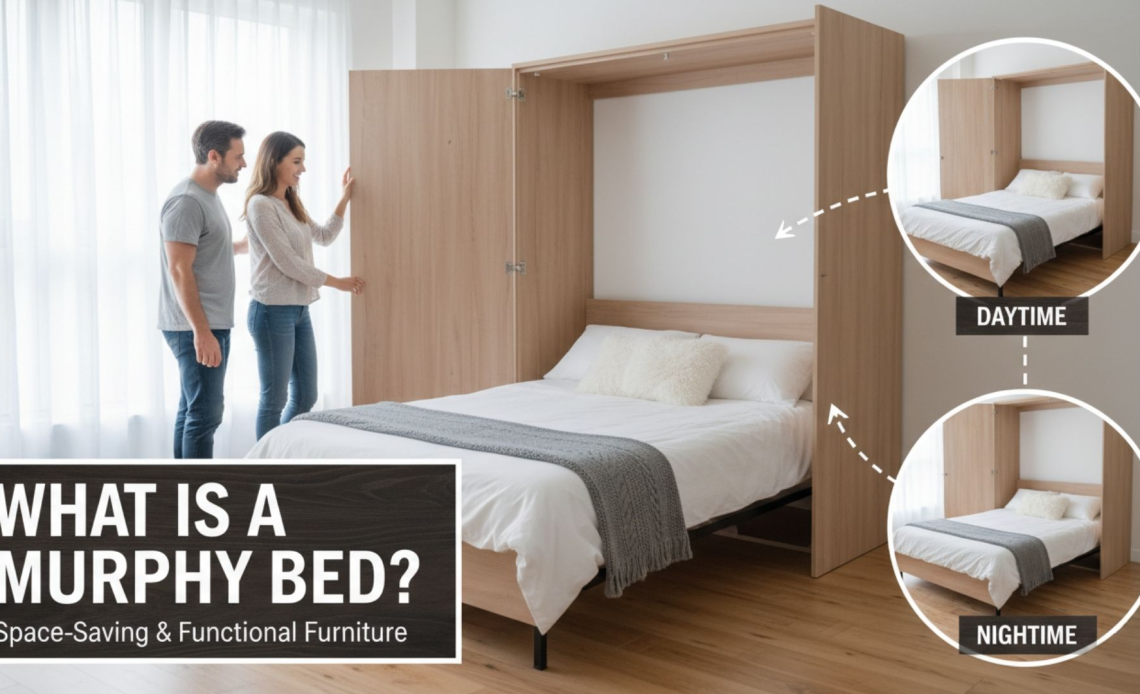
Walk into almost any small city apartment or multipurpose guest room and you are likely to find a bed hidden in plain sight.
Closed, it looks like a tidy cabinet or wall of shelving. Open, it becomes a full sleeping surface. That is the basic idea behind a Murphy bed.
If you are trying to squeeze more function out of a tight floor plan, understanding how these beds work, what they cost in tradeoffs, and where they shine can help you decide whether one belongs in your home.
Murphy Bed Basics
At its core, a Murphy bed is a full framed bed that folds vertically against a wall or into a cabinet when it is not in use.
The frame is hinged at one end so the entire bed can pivot up, mattress and all, to sit flat against the wall surface.
You will also hear other names for the same concept, such as wall bed, pull down bed, or fold down bed. All describe a sleeping surface that tucks out of the way to free up floor space during the day.
Inside the cabinet, a counterbalanced mechanism does the heavy lifting. Earlier Murphy beds used coiled springs that had to be adjusted over time.
Many modern systems rely on gas pistons or improved torsion springs that let you guide the bed up and down with one hand.
The mattress usually rests on a platform or mesh base rather than a box spring and straps or rails keep it in place when the bed is stored upright.
Strictly speaking, Murphy bed began as a brand name, tied to an early manufacturer of wall beds.
Over time it became the everyday term for almost any bed that folds into a wall, much the way people use tissue and a certain brand name interchangeably.
In today’s market, manufacturers may use Murphy bed and wall bed side by side, even when the internal mechanisms differ.
Read More: Saving Space with 10 Multifunctional Furniture Ideas for Stylish Small Living
History of the Murphy Bed
The idea of a bed that tucks away is not new. Folding bureau beds existed in the eighteenth and nineteenth centuries, though they never truly caught on.
The version we recognize today is credited to William Lawrence Murphy, who began filing patents around 1900.
According to accounts, Murphy lived in a small apartment in San Francisco at a time when social rules frowned on women entering a man’s bedroom.
His solution was a bed that could fold into a closet, instantly transforming a sleeping area into a respectable parlor.
From there, Murphy beds spread into compact urban apartments, hotels, and boarding houses where every square foot had to work hard.
By the mid twentieth century they were so common that collapsing wall bed gags became a staple of early film comedies. Fast forward to today and space pressure is once again intense.
Global research on wall beds estimates the market at roughly 3.5 billion US dollars in 2023, with projections close to 7 billion by 2035, driven by smaller homes and demand for multifunctional furniture.
How a Murphy Bed Works in a Modern Home?
Turning One Room into Two
- Most homeowners look at a Murphy bed when one room has to do double duty. You might have:
- A home office that needs to convert into a comfortable guest room a few nights a month.
- A tiny studio where the bed dominates the floor and you want real living space during the day.
- A playroom or hobby space that must occasionally host overnight visitors.
Because the bed folds up into a cabinet, the same room can host video calls, workouts, or crafting in daylight hours and still offer a proper mattress at night.
Modern Murphy beds are commonly used this way to transform rooms into multifunctional spaces, particularly where flexibility and floor area are tight.
Where Murphy Beds Make the Most Sense
These beds show up wherever square footage is precious. They are popular in small houses, city apartments, vacation condos, mobile homes, hotels, and college dormitories.
Anywhere a standard bed would swallow the room, a wall bed can return that footprint to everyday living. Murphy beds also appeal to people who dislike sleeping on sofa beds or futons.
Because you are using a regular mattress, comfort can be comparable to a traditional bed, which makes them a viable choice even for nightly use when the mechanism and mattress are good quality.
Common Types of Murphy Beds
Vertical and Horizontal Layouts
The classic Murphy bed folds vertically, with the head of the bed closest to the wall and the foot lowering toward the floor. This works well on taller walls and tends to feel most like a typical bed once opened.
Horizontal designs mount the long side of the mattress against the wall and swing out sideways instead. These can be practical in rooms with low ceilings, awkward window placements, or long narrow walls.
They also change how the bed projects into the room, which can help you maintain walking paths around desks or sofas.
Cabinets with Storage, Sofas, or Desks
Many Murphy beds are no longer just a bed in a box. Manufacturers offer units with side wardrobes, bookshelves, overhead cabinets, or even full desks and sofas built into the same wall system.
In a home office, a bed that folds down over a fixed desk lets you keep computers and paperwork in place while the frame swings down over the work surface.
In a small living room, a bed that hides behind a sofa can provide guest sleeping without sacrificing seating the rest of the time.
These combinations are part of the broader trend toward furniture that performs several roles in one footprint.
Mechanisms and Mattresses
Behind the cabinet face you will usually find one of two lifting systems. Traditional Murphy beds rely on metal spring arms that are tensioned to counterbalance the weight of the bed and mattress.
These may require periodic adjustment as springs fatigue. Newer designs often use gas piston systems which provide smoother, quieter motion with less effort.
Most Murphy beds are designed for standard mattress sizes, from twin through queen and sometimes king, though maximum thickness and weight are limited so that the bed can close properly and the mechanism stays balanced.
Instead of a box spring, mattresses sit on platforms, slats, or mesh bases, and straps keep bedding in place when you fold the bed away.
Read More: Creating a Home Office Design Ideas for Productivity and Comfort: Your Ultimate Guide
Pros and Cons of a Murphy Bed
Key Advantages
The clearest advantage is space. Folded up, a Murphy bed can return several square meters of clear floor to circulation, exercise, work, or play.
In small urban homes where every square foot is expensive, that reclaimed space can feel like gaining an extra room.
Comfort is another strong point. Unlike many sofa beds, a good wall bed can take a quality mattress that supports nightly sleep.
For frequent guests or studio dwellers, that can be the difference between “it will do” and genuinely restful rest.
Murphy beds also encourage tidiness. Because you must fold the bed away, the room naturally resets each morning.
In multipurpose rooms, this can help keep work and rest mentally separate, even when they share the same four walls.
Tradeoffs and Limitations
A Murphy bed is not a budget substitute for a basic metal frame. Even off the shelf systems cost more than many standard beds, and custom cabinetry or high end mechanisms add to the investment.
Installation is another consideration. Wall beds must be firmly anchored to wall studs, and some older designs also bolt to the floor.
If you rent, you will need landlord permission for that level of fastening and you may be responsible for repairs when you move out.
Professional installation is often recommended, especially for larger units with integrated storage.
There are safety factors as well. Any large, moving piece of furniture carries some risk if installed incorrectly or misused.
Poorly secured wall beds have been linked to injuries and, in rare cases, deaths, leading to product recalls and updated safety standards.
Choosing a reputable manufacturer, following weight and mattress guidelines, and having the bed properly fixed to the wall are essential steps.
Consider practicality. If the bed is used every night, you or your guests will fold it up and down twice a day. Most modern systems make that quite easy, but it is still a small daily task and may not suit everyone’s habits.
How to Decide if a Murphy Bed?
Before you shop, think about who will use the bed and how often. A guest room that sees visitors twice a year can get by with a simpler mechanism than a studio apartment where the bed is used nightly.
Families with young children, pets, or older adults should pay particular attention to safety locks, smooth closing systems, and clearances around the bed.
Measure the room carefully. You need enough wall width and ceiling height for the cabinet, plus clearance for the bed to extend fully into the room.
Check where doors, radiators, and windows sit, and imagine how the room will function when the bed is down.
In tight spaces it is often worth sketching the layout or using painter’s tape on the floor to outline the footprint.
When comparing products, look beyond the front panel design. Ask about the type of lifting mechanism, the range of mattress thickness it supports, and the rated weight capacity.
Check whether the bed can be disassembled and reinstalled if you move, what kind of warranty is offered, and whether professional installation is available in your area.
If you plan to work in the room, consider integrated desks or shelving so the wall bed can replace not just a bed but also a separate storage unit or bookcase.
Although these options cost more up front, they can simplify the room and reduce the number of individual furniture pieces you need to buy.
Read More: What Is A Sleigh Bed? Everything You Should Know
Conclusion
A Murphy bed is essentially a full size bed on a clever hinge, but its impact on how a room feels is substantial.
By lifting the mattress into the wall or a cabinet, you allow a single space to switch roles between day and night without sacrificing real sleep comfort.
It is not the right answer for every home. The cost, installation requirements, and the discipline of folding it up daily all need honest consideration.
For small homes, multifunctional rooms, and anyone who wants a true mattress in a space that cannot spare a permanent bed, however, a well chosen Murphy bed can be one of the most effective space solutions you add to your home.
