
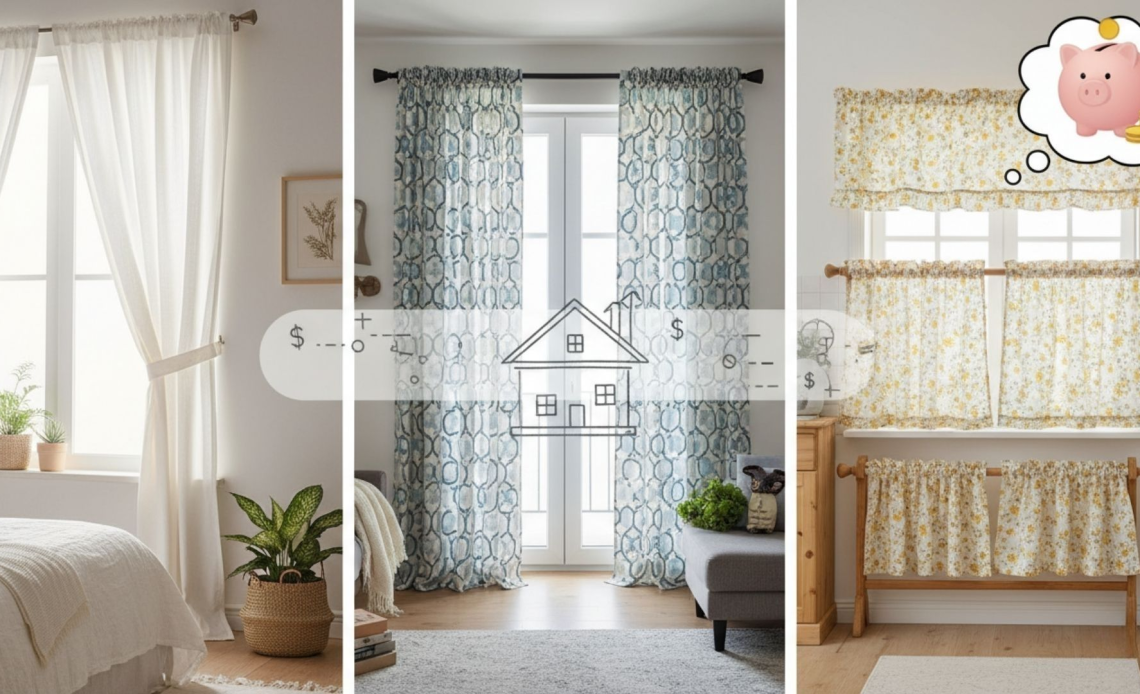
Curtains are one of the quickest ways to change how a room feels, yet they are also one of the easiest places to overspend.
Custom fabrics, intricate hardware and professional installation can push costs up fast, but you do not need any of that to get a polished, pulled together look.
With a bit of strategy and a few smart shortcuts, you can dress every window in your home on a realistic budget.
Below are ten affordable curtain ideas that work across living rooms, bedrooms, kitchens, home offices and even rentals, with practical notes on where they shine and how to keep costs in check.
1. Ready made panels for instant polish
The simplest budget friendly move is to skip custom work and lean on ready made curtain panels. Polyester and polyester blend panels are widely available, machine washable and often sold in sets of two for the price of a single custom panel.
Many mass market options come in popular sizes like 52 inches wide by 84 inches long and are designed to fit standard rods with rod pockets or grommets.
To make inexpensive panels look more tailored, focus on how you hang them. Mount the rod a few inches above the window frame and extend it past each side so the panels can stack off the glass.
That small adjustment makes even basic curtains feel taller and more luxurious while still staying within a modest budget.
2. Sheer curtains to brighten small spaces
Sheer curtains are one of the most economical choices per panel, yet they have an outsized effect on a room. Lightweight polyester sheers soften daylight, blur busy views and add privacy during the day without making a space feel closed in.
They are ideal for small living rooms, dining rooms and home offices where you want light more than darkness.
Because sheers use less fabric and simpler construction, they typically cost less than heavier panels. You can use them alone in bright spaces or pair them with blinds and shades you already own.
A simple double rod lets you add sheers in front of existing hardware without replacing anything, which keeps your total spend low while still giving the window a finished look.
Read More: Make Your Bedroom Extra Cozy: 16 Decor Ideas
3. Blackout curtains for better sleep and lower bills
If you are going to invest a little more anywhere, do it in the bedrooms. Blackout curtains use thicker or specially woven fabric that blocks most outside light, which helps regulate your sleep cycle and is especially helpful for shift workers, children’s rooms and nurseries.
The bonus is energy savings. Thermal blackout panels add an extra layer of insulation over drafty windows, which means less heat loss in winter and less heat gain in summer.
Several widely sold blackout lines that include a thermal layer are priced in the range many households consider affordable, especially when you factor in potential savings on heating and cooling over time.
Choose simple solid colors in a classic header style so you can move panels between rooms as your needs change. That flexibility stretches your budget further than a highly specific pattern would.
4. DIY drop cloth curtains that look custom
One of the most popular designer tricks in recent years is turning plain canvas drop cloths into curtains.
Hardware stores and big retailers sell painter’s drop cloths in sizes like 6 by 9 feet, often around ten dollars each, and in many homes a single cloth can become one full length panel.
That means you can dress an average window with two tall panels for roughly twenty dollars in fabric.
The process is surprisingly simple. Wash and dry the drop cloths to soften them, then either clip them to curtain rings or fold and sew a basic rod pocket.
Because the fabric has a natural, slightly slubby texture, it reads much like more expensive linen. Hang them high and let them just kiss the floor for an intentionally relaxed, custom look at a fraction of the usual cost.
5. Flat sheet curtains as a rental friendly hack
If you already own spare flat sheets, you are halfway to new curtains. Even if you buy them, basic twin or full flat sheets often cost less per yard than many decorator fabrics, especially through discount and clearance channels where single sheets can run under fifteen dollars.
Turn them into curtains with clip rings or by sewing a simple pocket along one long edge. Sheets are designed to be durable and washable, so they stand up well in high traffic rooms, kids’ spaces and guest rooms.
Solid white or simple stripes give a calm, hotel inspired feel, while printed sheets can bring pattern into a room without the premium price of designer textiles.
Read More: How To Mix And Match Bedroom Furniture?
6. Cafe curtains for kitchens and baths
Full length curtains do not always make sense in kitchens and bathrooms, where you need privacy but also want to keep fabric away from splashes and steam. Cafe curtains, which cover only the lower half of a window, are a budget winner here.
Because they use less fabric, they usually cost less than full length panels, and for small windows you can sometimes get away with a single panel split down the middle and hemmed.
Mount a tension rod or small cafe rod midway up the window, then add a short, lightweight panel. In a kitchen, pair the cafe curtain with a simple valance at the top if you want a softer look.
In a bathroom, choose moisture friendly fabrics and keep styles simple so they are easy to launder.
7. Tension rod curtains where drilling is not allowed
For rentals or older homes with delicate trim, tension rods are a smart, low cost solution. They wedge between two walls inside the window frame, so you do not need screws or anchors.
This makes them ideal for small bathrooms, laundry rooms and temporary setups like nurseries or student housing.
You can pair tension rods with short lightweight panels, sheers or even cut down flat sheets. Because everything is contained inside the frame, the hardware is discreet, which keeps the look clean even when the components themselves are inexpensive.
When you move, the rod and panels come with you and can be reused in the next place.
8. Layered look without a designer budget
Layered window treatments always read more high end than a single lonely panel. The good news is you can create that layered look without doubling your costs.
Start with a basic blind or shade you already have, then add an affordable sheer panel over it. For more privacy or light control, add a second rod above the first and hang a solid blackout or room darkening panel in front.
This gives you three settings for the price of two components. Open everything for maximum light, close only the sheer and shade for filtered light, or draw the heavy panel when you want a dark, cozy room.
Sticking to neutral solids in at least one of the layers lets you swap pieces around the house as your style evolves, rather than buying new for every window.
9. Patterned panels as a focal point
If you love pattern, you do not need to cover every window to make an impact. Choose one key wall or one pair of windows in a living room or bedroom and invest in patterned panels there.
Florals, bold stripes or geometric prints instantly draw the eye and can stand in for more expensive elements like statement wallpaper or an oversized rug.
To keep costs manageable, look for printed polyester panels instead of natural fibers. Because you are using pattern in a limited way, you can reserve more neutral, lower cost curtains for the other windows in the same room.
This approach gives you a designer style focal point but still respects a whole home budget.
10. Curtain room dividers to reshape a space
Curtains are not only for windows. Tall panels on ceiling mounted tracks can work as flexible room dividers in studio apartments, shared kids’ rooms or open plan living spaces.
Compared to building a permanent wall, fabric dividers are extremely cost effective and easy to reverse.
Look for simple solid panels in longer lengths, then hang them from a track or multiple rods mounted close to the ceiling.
When open, they stack neatly at the sides. When closed, they create privacy for sleeping, working or dressing.
Using affordable blackout or thermal panels here can also muffle sound and block light between zones, which is helpful if you are trying to carve a bedroom out of a living area.
Read More: Wardrobe Designs for Small Bedrooms With Sliding Doors
Conclusion
Affordable curtains are less about one magic product and more about a few smart habits. Choose ready made panels over fully custom work, repurpose materials like drop cloths and flat sheets where it makes sense, and reserve your splurges for rooms that truly need blackout control or a bold pattern moment.
Hang everything a little higher and wider, and even the most basic fabric starts to feel intentional.
With these ten ideas, you can dress every window in your home without watching the budget spiral. Start with one room, reuse what you already own, and add pieces slowly.
Over time, you will end up with a house full of windows that look finished, feel comfortable and quietly support the way you actually live.
