
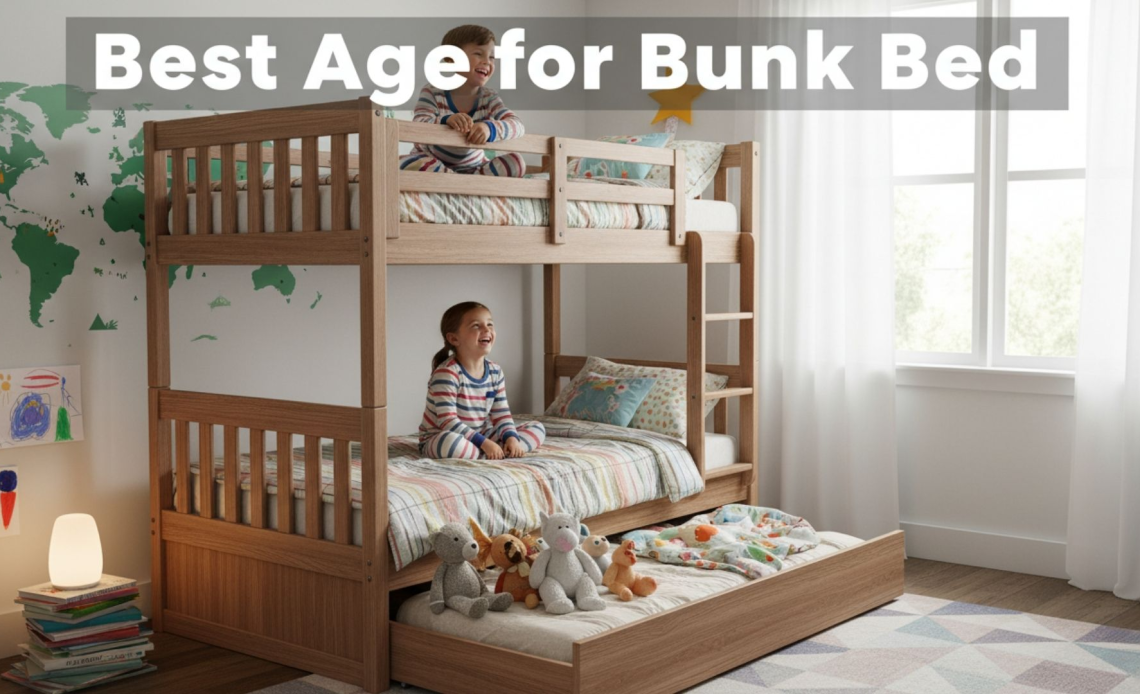
If you live with more than one child, there is a good chance someone has already begged for a bunk bed. It saves floor space, looks fun, and feels like a milestone.
At the same time, most parents have also heard at least one scary story about falls or late-night trips to the emergency room.
So when is it actually safe to move a child into a bunk bed, and especially the top bunk? The answer is not whenever they ask. Age matters, but so do maturity, coordination, and how you set the bed up.
What Is the Safest Age for a Bunk Bed?
Most safety organizations agree on one firm line: no child under 6 years old should sleep in the top bunk.
The American Academy of Pediatrics and the U.S. Consumer Product Safety Commission both warn that younger children do not yet have the coordination or judgment to climb safely or to avoid rolling out of a high bed while asleep.
The bottom bunk is more flexible. Many children can safely move there once they have outgrown the crib or toddler bed and can get in and out of bed on their own.
For most families that falls somewhere between ages 3 and 6, with a lot of variation by child.
Top bunk age guidelines
Research backs up those age limits. A large analysis in the journal Pediatrics estimated that more than 570,000 children and young adults were treated in U.S. emergency departments for bunk-bed related injuries over 16 years, with younger children especially at risk.
An American Academy of Pediatrics news report notes that roughly half of children injured in bunk-bed incidents are younger than 6, which is why experts draw such a firm line at that age.
In simple terms:
- Younger than 6: top bunk is off-limits for sleep and should not be used as a play space.
- Around 6 to 7: top bunk may be okay for some children who are coordinated, follow rules, and do not roughhouse.
- Older than 7 or 8: most children physically manage the top bunk well, provided the bed meets modern safety standards and house rules are clear.
Even at 6 or 7, you know your child better than any guideline. If they are impulsive, love to jump from high places, or wake at night confused, it is smart to wait.
Bottom bunk age guidelines
There is no official universal minimum age for the bottom bunk, because it is low to the ground and much less risky in a fall. Many manufacturers and pediatric sleep experts suggest that once your child:
- can climb in and out of bed independently, and
- no longer needs the containment of crib rails
They can usually move to a bottom bunk with guardrails. For some children that is as early as 2 or 3, but for many it feels easiest between 3 and 5 years old.
As you decide, think of the bottom bunk as similar to any standard kid’s bed. If your child is still learning not to roll or gets up and wanders at night, you may want a low toddler bed or floor bed first.
Read More: How To Build A Trundle Bed?
When is Your Child Ready for a Bunk Bed?
Age is one part of the picture. Readiness also depends on personality, habits, and physical skills. Before you switch, ask yourself:
- Can they safely climb? Watch them on ladders, playground structures, and stairs. Do they move steadily, or do they rush and skip steps?
- Do they follow safety rules? If you say “no jumping off the bed,” do they listen, or does it immediately turn into a game?
- Do they stay asleep most nights? Children who often wake disoriented, sleepwalk, or run to their room at night are not good candidates for the top bunk.
- Are there younger siblings around? If you have a toddler in the house, you will need a plan to keep them from climbing the ladder or playing on the top bunk.
If a child is old enough on paper but does not yet pass those everyday tests, treat that as a sign to wait or to keep them on the bottom bunk for now.
How Bunk Beds Fit Into Each Stage?
Toddlers under 3 years
For toddlers, the safest choices are still a crib that meets current standards or a very low bed. At this age, the risk is not only falling from the top bunk.
Studies of bunk-bed injuries show that many of the most serious cases involve very young children who become trapped between the mattress and wall or inside bed openings.
In one regulatory review, over 96 percent of fatal entrapments involved children age 3 or younger. Keep bunk beds off the table. If you already own one, block access to the ladder and avoid using it as a climbing toy.
Preschoolers 3 to 5 years
Preschool years are when many families first consider a bunk bed. Space gets tight, siblings start sharing rooms, and children crave a “big kid” setup.
At this age:
- The bottom bunk can work for many children, as long as it has a secure guardrail, a mattress that fits snugly, and is not too high off the floor.
- The top bunk is still not safe for sleep. Even if a 4-year-old can scramble up the ladder, they are more likely to misstep in the dark or roll during deep sleep.
Injury surveillance data from Canada shows that children 3 to 5 years old are the group most frequently injured in upper-bunk falls, which is a strong reason to hold that firm “no” on top bunks until at least 6.
Tweens and teens
By 10 and up, physical readiness is usually not the issue. Instead, focus on:
- Weight limits: Check the manufacturer’s rating for each bunk and confirm that the frame and slats are still solid and tight.
- Head clearance: A tall tween who sits up quickly can hit their head on the ceiling or underside of the upper bed.
- Study and sleep needs: A loft-style bunk with a desk underneath can free space for older kids, but all the top-bunk safety rules still apply.
If a bunk bed starts to feel cramped, creaky, or too low for your teenager’s height, it may be time to separate it into two single beds if the design allows.
Read More: Best 12 Weighted Blanket Deals
Non-Negotiable Safety Rules at Every Age
Once you are confident about the age and readiness, the way the bed is set up matters just as much.
Research on bunk-bed injuries shows that most accidents involve falls from the upper bunk, especially when there are missing or inadequate guardrails.
A few rules should always be non-negotiable:
- The top bunk must have guardrails on both sides, with openings small enough that a child’s head cannot slip through.
- The top mattress should fit the frame snugly and sit low enough that the guardrail still rises several inches above the mattress surface, as current safety standards require.
- The ladder should be permanently attached, stable, and easy to grip, with a night-light nearby so children can see the steps at night.
- Never place the bunk bed directly under a ceiling fan or close to a window where a child could reach cords or glass.
- Teach and repeat the rule that there is no jumping, pushing, or roughhousing on or under the bunks.
- Make it clear that only one child is allowed on the ladder or top bunk at a time.
If your bunk bed is older or secondhand, read the model label if available and look up whether it meets current standards.
Avoid adding aftermarket rails or accessories that are not designed for your specific bed, since they can create new entrapment gaps.
Conclusion
Age is only one part of the bunk bed decision, and the safest way to think about it is in layers. The bottom bunk usually becomes an option once your child is confidently out of a crib and can get in and out of bed alone, often somewhere between 3 and 6.
The top bunk or a loft needs a stricter cutoff, which is why experts recommend waiting until at least age 6, and even then only for kids who are steady on ladders, follow rules, and do not tend to wander or wake confused at night.
A sturdy frame that meets current standards, secure guardrails on both sides, a snug mattress, a fixed ladder, good night lighting, and a clear rule that the top bunk is for sleeping instead of play.
Combined with your own judgment about your child’s temperament, coordination, and sleep patterns, those steps let a bunk bed become a practical space saver and a fun milestone without losing sight of safety.
